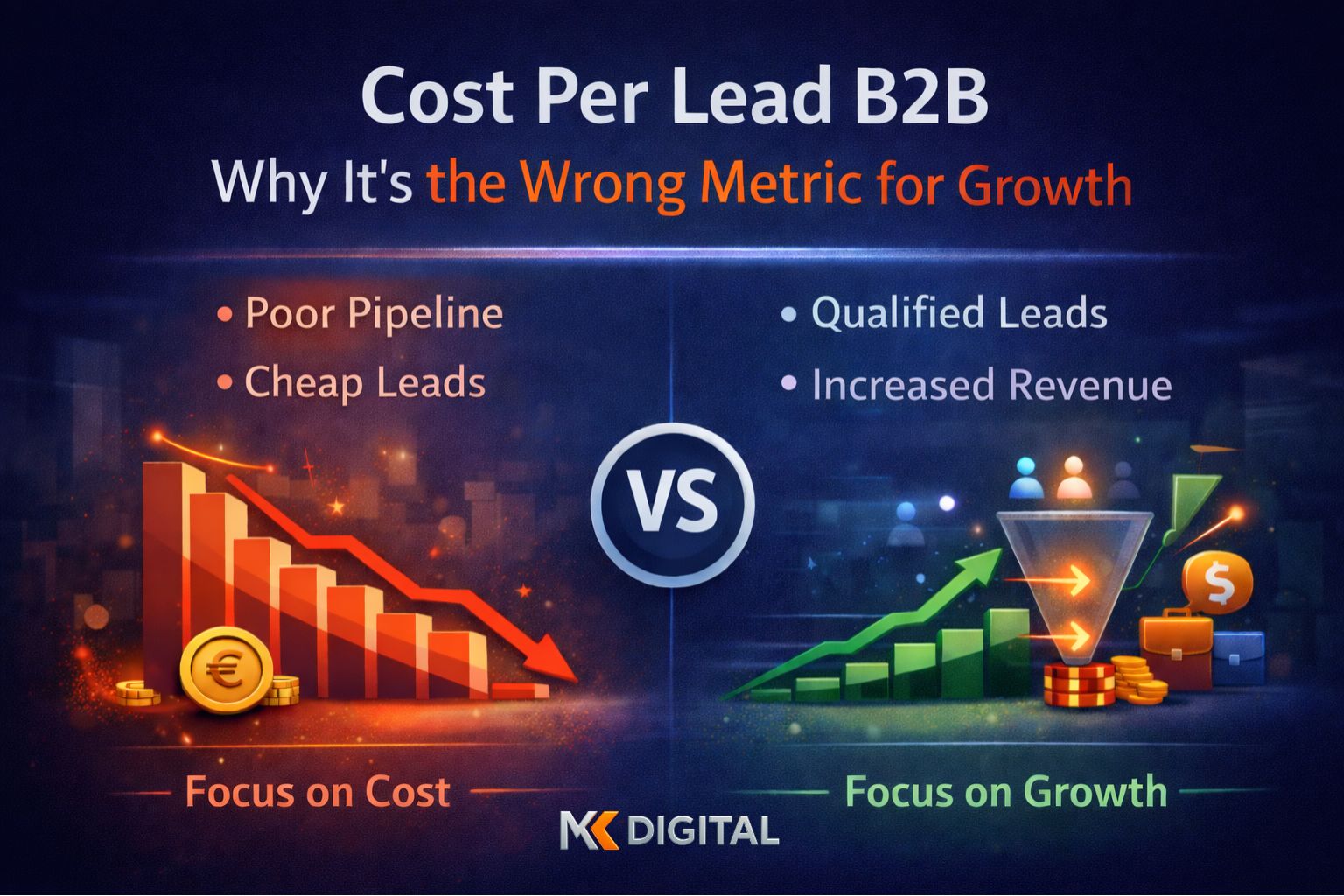
Cost Per Lead B2B: Why It’s the Wrong Metric for Growth
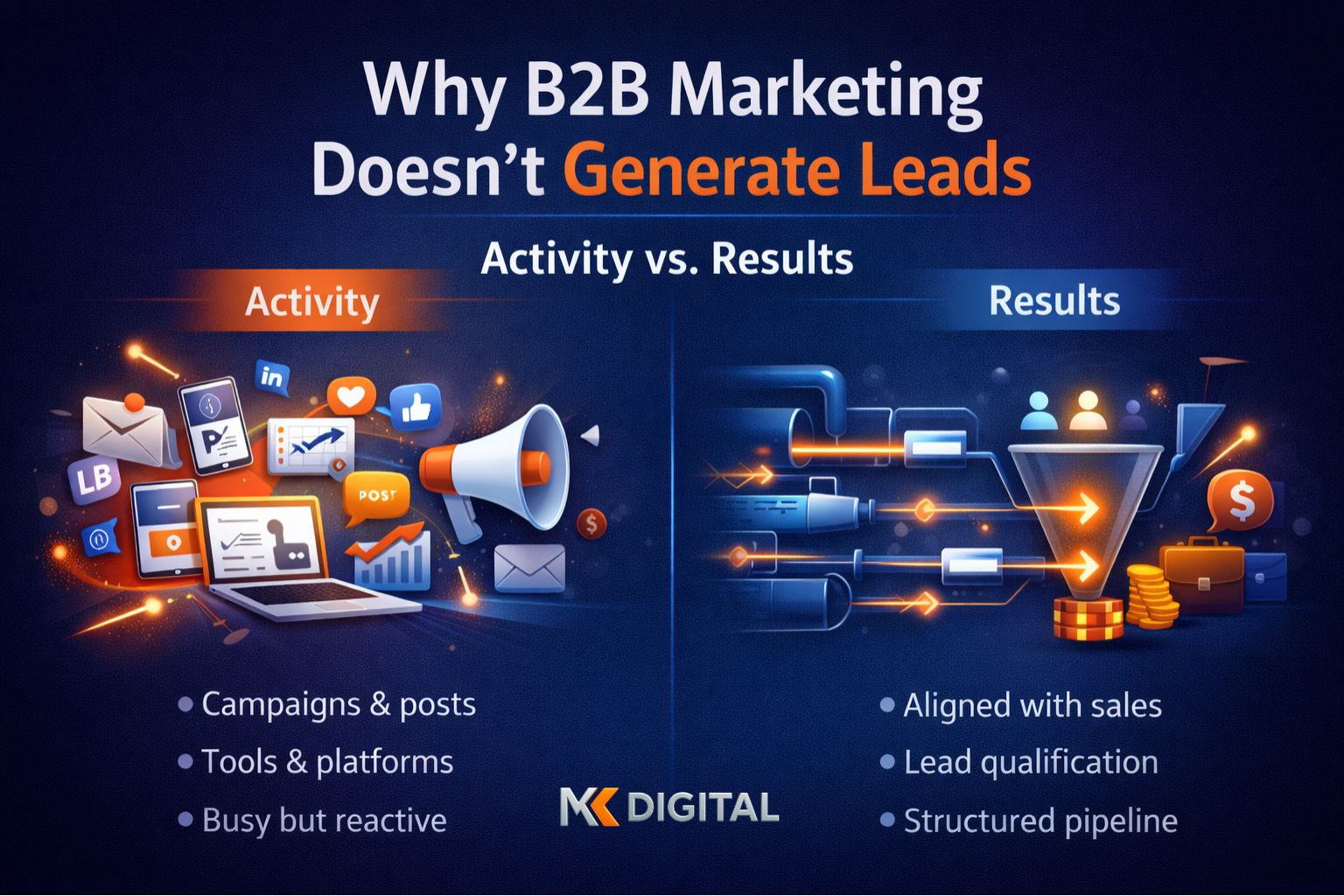
Let’s start with something uncomfortable.
If your marketing conversations are focused on cost per lead B2B, there’s a good chance you’re optimizing the wrong thing.
Lower cost per lead B2B feels good because it looks efficient.
At the same time, it’s easy to report and compare.
However, it often comes at a hidden cost: slower growth, weaker pipeline, and poor-quality opportunities.
Because in B2B, cheap leads are rarely the ones that actually close.
Why cost per lead B2B is misleading
On paper, cost per lead looks like a clean metric.
For example, you spend €10,000 and generate 200 leads.
As a result, your cost per lead is €50.
Sounds great, right?
Not necessarily.
The reason is simple.
Cost per lead tells you only one thing: how much you paid for a contact.
At the same time, it doesn’t explain what happens next.
It tells you nothing about:
- whether that contact is qualified
- whether they fit your ICP
- whether they will enter your pipeline
- whether they will generate revenue
Therefore, many B2B companies fall into the same trap.
They optimize for volume instead of value.
More leads → lower cost per lead → better reports
…but not better outcomes.
The real problem: volume vs value
Let’s look at two scenarios.
Scenario A
- 200 leads
- CPL: €50
- 5% qualified
- 10 opportunities
- 1 deal
Scenario B
- 50 leads
- CPL: €200
- 40% qualified
- 20 opportunities
- 5 deals
At first glance, Scenario A looks more efficient.
However, when you focus on revenue, Scenario B clearly wins.
So why do companies still push to reduce cost per lead?
Because it’s easy to measure.
Unfortunately, this leads to:
- broader targeting
- weaker messaging
- more low-intent leads
As a result, the pipeline looks full, but doesn’t convert.
What to measure instead of cost per lead B2B
You don’t need to ignore cost per lead completely.
Instead, you need to put it in the right context.
Here’s what actually drives growth.
Pipeline (not just leads)
Leads don’t grow your business.
Pipeline does.
So instead of asking:
„How many leads did we generate?”
Ask:
„How much pipeline did marketing create?”
This simple shift changes everything.
This is where a structured approach to
B2B lead generation becomes critical.
Customer Acquisition Cost (CAC)
Cost per lead B2B is only a fragment.
In contrast, CAC shows the full picture.
It includes:
- marketing spend
- sales effort
- time required to close
Therefore, a low cost per lead combined with a high CAC is a warning sign.
It means your system is inefficient.
Without a clear B2B marketing strategy,
CAC becomes difficult to control.
Revenue (the only real KPI)
At the end of the day, the question is simple:
Is marketing generating revenue?
Not impressions.
Not clicks.
Not leads.
Revenue.
Because everything else is just a proxy.
When CPL optimization fails
This pattern appears again and again.
A company reports:
- strong lead volume
- attractive cost per lead B2B
- active campaigns
However, when we look deeper:
- sales teams complain about lead quality
- conversion rates are low
- deals take too long
The issue?
Marketing was optimized for cost per lead,
not for pipeline or revenue.
Once we shift the focus:
- targeting becomes sharper
- messaging becomes clearer
- content aligns with real buyer intent
As a result, something interesting happens.
Cost per lead B2B goes up.
But:
- pipeline grows faster
- sales cycles become shorter
- revenue increases
The uncomfortable truth
Lower cost per lead B2B is not a strategy.
It’s just a metric.
And when you build your strategy around a metric, you risk making poor decisions.
For example:
- attracting the wrong audience
- optimizing for volume
- losing connection with revenue
Conclusion: cheap leads don’t scale B2B
If you remember one thing, let it be this:
Cheap leads don’t build pipelines.
Smart decisions do.
Start with clarity, not assumptions
If your cost per lead B2B looks good…
but your pipeline doesn’t,
it’s time to go deeper.
Start with a B2B Marketing Diagnosis from MK Digital.
We’ll show you:
- where your system breaks
- what actually drives revenue
- how to move from leads → to pipeline → to growth
No assumptions.
No guesswork.
Just clarity.