
Why B2B Marketing Doesn’t Generate Leads: 9 Problems to Diagnose

A company can publish content, invest in SEO, attend trade shows and run LinkedIn campaigns without creating a reliable flow of qualified opportunities. Marketing looks active, the monthly report contains plenty of numbers, yet sales still says that not enough useful conversations are entering the pipeline.
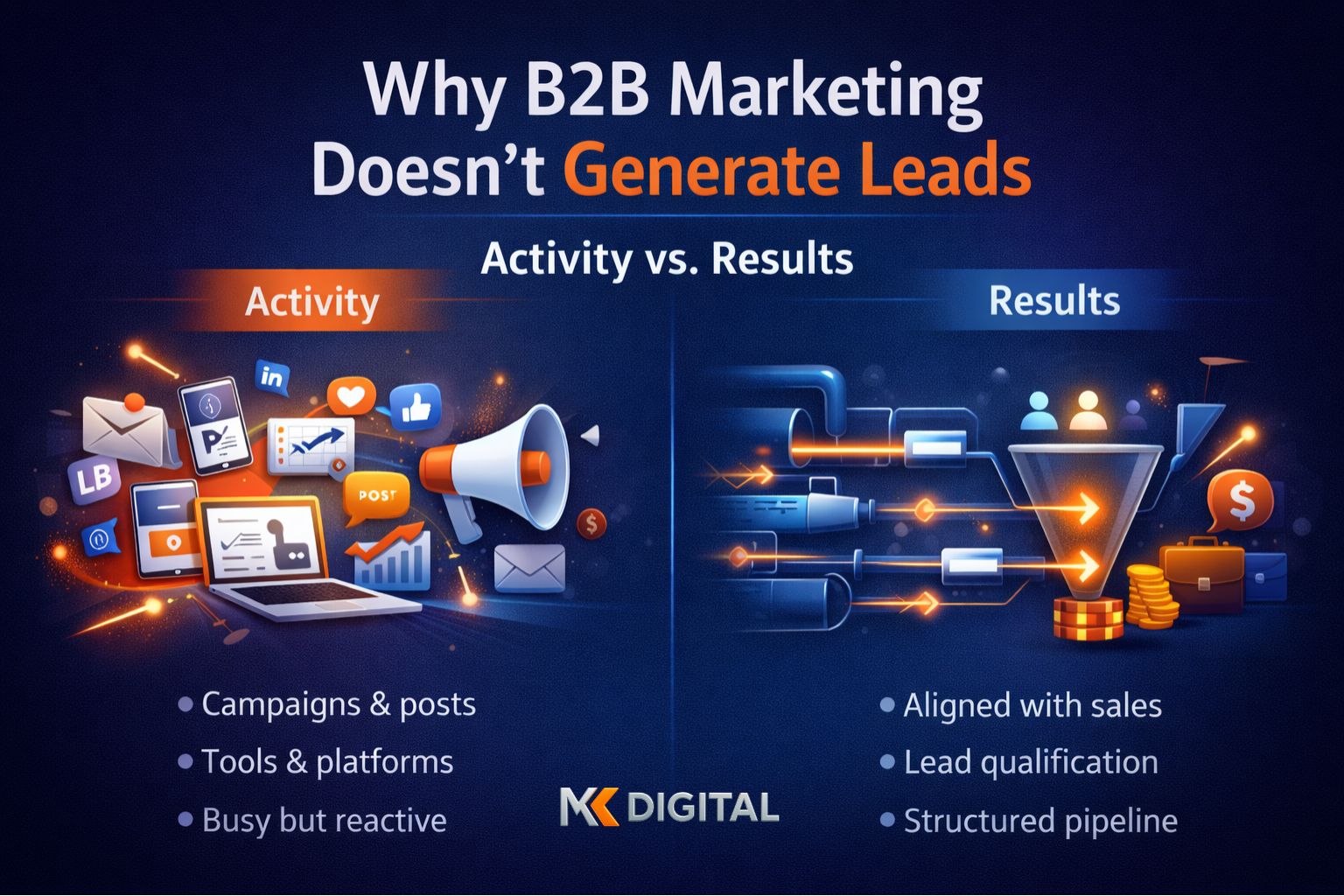
When this happens, the usual reaction is to increase activity. More content is commissioned, another campaign is launched or additional budget moves into paid media. However, that response assumes the problem is insufficient volume.
Often, it is not.
Understanding why B2B marketing doesn’t generate leads requires looking at the entire commercial system. The problem may sit in targeting, positioning, visibility, conversion, qualification, sales follow-up or somewhere further down the pipeline.
The objective is therefore not to ask whether marketing is doing enough. It is to identify the specific transition where buyer interest stops becoming commercial value.
B2B marketing can fail before a lead ever exists
Most lead-generation reporting begins when somebody becomes identifiable. A visitor completes a form, registers for an event or asks for more information, and marketing records a conversion.
The buyer journey begins much earlier.
European research from 6sense in 2026 found that buyers made first contact with sellers 57% of the way through an average 10.3-month evaluation. The eventual winner was already on the day-one shortlist in 92% of purchases, while 88% of buying groups had ranked vendors before seller contact.
This means a company can have a lead-generation problem even when its forms, campaigns and sales team work reasonably well. Buyers may simply fail to notice or consider the supplier during the earlier stages when preferences are being formed.
A useful diagnosis therefore starts before conversion.
Problem 1: You are attracting the wrong market
One of the clearest symptoms is reasonable lead volume combined with constant complaints about lead quality. Marketing reports conversions, but sales rejects a large proportion of them or struggles to turn them into credible opportunities.
The likely problem is not the landing page. It may be the ICP.
A broad definition such as „manufacturing companies”, „engineering businesses” or „SMEs” gives campaigns too much room to attract organisations that could theoretically buy but are commercially unattractive.
Start by comparing marketing’s target audience with the customers sales actually wants. Examine sector, geography, company size, applications, deal value, buying structure and characteristics of the strongest existing customers.
Then review rejected leads.
If a large percentage consistently falls outside the preferred customer profile, the next investment should go into targeting and segmentation rather than traffic generation.
The diagnostic question is simple:
Are we failing to generate leads, or are we generating demand from companies we never really wanted?
Problem 2: Buyers cannot see enough difference between you and competitors
A second pattern appears when marketing generates enquiries but sales conversations move quickly towards price.
This often indicates weak differentiation.
Many B2B websites describe experience, quality, innovation, technical knowledge and customer service. Those qualities may all be genuine, but competitors usually make similar claims.
When buyers cannot identify a meaningful commercial difference, price becomes an easy comparison tool.
The diagnosis should therefore examine messaging before campaign performance. Ask whether the website clearly explains which customer problems the company solves particularly well and why its approach creates a better outcome.
Look at the evidence too.
Faster turnaround, stronger technical support, lower maintenance, reduced implementation risk or better lifecycle economics are more useful when they can be demonstrated through data, projects or customer examples.
If marketing attracts interest but buyers still perceive the company as interchangeable, more lead volume will not solve the underlying problem.
Problem 3: The company becomes visible too late
Some businesses receive enquiries almost entirely when buyers are ready to request a quotation. That can create the impression that marketing works, but the company may already be entering the decision too late.
By the time an RFQ appears, the shortlist can be largely formed.
Requirements may also have been shaped by competitors, consultants or suppliers that became useful earlier in the process.
This is particularly important in industrial, engineering and technical B2B markets. Technical articles, specification guidance, webinars, CPDs, case studies and expert commentary can all influence how buyers define a good solution before procurement becomes active.
The diagnostic task is to understand where current demand originates.
If most opportunities appear through branded searches, referrals or direct enquiries from people who already know the company, marketing may be capturing existing preference rather than creating new preference.
Look instead at non-branded search visibility, relevant account engagement and earlier-stage content consumption.
The question becomes:
Are buyers discovering us while they are still deciding what matters, or only after the important decisions have already been made?
Problem 4: Not enough relevant demand exists
Sometimes the problem really is volume.
The company has clear positioning, a well-defined ICP and reasonable website conversion, but too few suitable buyers are entering the system. Sales relies heavily on referrals, existing relationships or sporadic tenders because the market rarely encounters the company elsewhere.
This is a genuine demand-generation problem.
The diagnosis should separate demand creation from demand capture. Search captures buyers who already know enough to look for a solution, while LinkedIn, industry media, events, content and outbound can create familiarity earlier.
A company relying exclusively on Google may simply be competing for the small percentage of the market already searching. Conversely, a business focused only on awareness may create visibility without giving buyers a clear route towards commercial action.
Check how many relevant accounts marketing reaches, how much non-branded search visibility exists and which channels consistently introduce new companies into the pipeline.
If the right market rarely encounters the brand, additional demand activity may indeed be necessary.
Problem 5: Marketing generates traffic, but the website does not create progression
Another common pattern is steady growth in traffic without a corresponding increase in qualified enquiries.
This is not automatically an SEO failure.
The company may be attracting relevant visitors while giving them very little reason or opportunity to continue. Product pages can be too technical, service pages too generic and calls to action too aggressive for early-stage buyers.
A visitor researching a technical problem may not be ready to “Book a Consultation”. However, they might read a related case study, explore an application page or download useful technical guidance.
The diagnosis should therefore examine progression rather than traffic alone.
Which pages attract relevant visitors, and where do those people go next? Do they reach commercial pages, proof or deeper technical content? Are there useful next steps for different levels of buying readiness?
Also examine intent.
Traffic from broad informational keywords can grow rapidly without creating commercial value. If the pages generating most visits sit far outside the ICP or buyer journey, high traffic can hide a weak acquisition system.
The question is not simply whether people visit. It is whether relevant buyers move forward.
Problem 6: Your conversion mechanism asks for too much or too little
B2B websites often have one of two conversion problems.
Some ask for a sales meeting too early. Every page pushes the visitor towards the same high-commitment action even though much of the audience is still researching independently.
Others create dozens of low-value conversions.
Every checklist, newsletter signup and PDF download becomes a lead, even when the contact has shown little commercial intent.
Both models distort performance.
Gartner reported in 2026 that 67% of surveyed B2B buyers preferred a rep-free experience, which reinforces the need to let buyers progress independently before forcing sales involvement. At the same time, human sellers remain important when buyers need validation and confidence around complex decisions.
A stronger conversion architecture offers different next steps.
Early buyers can continue learning. Mid-funnel visitors can access proof and comparisons, while high-intent buyers can contact sales directly.
The goal is not to maximise form submissions. It is to create appropriate progression at different levels of buyer readiness.
Problem 7: Marketing calls everything a lead
Sometimes lead-generation performance appears weak because the organisation has never agreed what a lead actually means.
Marketing may count downloads, event registrations and contact forms together. Sales then receives a mixture of researchers, students, existing customers, suppliers and genuine prospects.
The resulting discussion becomes predictable: marketing says lead volume is growing, while sales says the leads are poor.
Neither side has enough structure to resolve the disagreement.
The first fix is definitional.
A Lead, MQL, SQL and Opportunity should represent distinct commercial stages. The criteria do not need to be complicated, but both teams should understand what must be true before a contact progresses.
Then analyse conversion between those stages.
If 500 leads create only ten MQLs, acquisition may be too broad. If many MQLs become SQLs but very few SQLs turn into opportunities, the problem sits elsewhere.
This is why qualification should diagnose lead generation rather than simply filter its output.
Problem 8: Sales receives the lead without enough context
A potentially strong lead can still fail when the handover is weak.
Imagine receiving only a name, company and email address. Sales knows that somebody filled in a form but has little understanding of the issue that attracted them or why marketing considered the account relevant.
Now compare that with a handover showing that the company fits the ICP, the contact read two articles about a specific operational problem, visited a service page and works in a relevant buying role.
The first sales conversation can become much more useful.
Check what information moves from marketing into CRM. Source, topic, account fit, relevant engagement and reason for qualification can all provide context.
Response time should also be examined.
A high-intent enquiry left untouched for several days can become a sales-follow-up problem even though marketing technically generated the lead successfully.
The diagnostic question is therefore not only„Did marketing generate a lead?”
It is „Did the commercial system know what to do with it?”
Problem 9: The lead was good, but the opportunity still disappears
Not every lead-generation problem belongs to marketing.
If sales accepts leads but few become opportunities, the bottleneck may sit in discovery, sales process or proposition. If opportunities are created but rarely close, the issue moves further down the funnel again.
This distinction matters because companies often respond to weak revenue by asking marketing for more leads.
Additional volume will only increase the number of opportunities reaching the same weak stage.
Look at SQL-to-opportunity conversion, opportunity progression, win rate and recurring lost-deal reasons. Compare results by segment and lead source.
For example, one channel may create expensive leads but strong opportunities. Another may produce cheap leads that sales accepts but rarely closes.
The strongest diagnosis follows commercial progression until the loss becomes visible.
Only then can the company decide whether the solution belongs to marketing, sales, positioning, pricing or product.
The problem may be proof, not demand
Some companies attract the right buyers and generate credible opportunities, but buyers still hesitate.
This can be a proof problem.
The website and sales materials explain what the company does but provide limited evidence that it can solve the buyer’s specific problem. Case studies are generic, testimonials contain little detail and technical claims remain unsupported.
That creates additional risk for the buying group.
In complex B2B, choosing a supplier often involves several stakeholders. Each may need evidence that the decision can be defended internally.
Review case studies, customer outcomes, technical data and implementation examples.
Do they answer the questions a sceptical buyer would ask? Do they show problems similar to those faced by the target customer?
If demand progresses until evaluation and then repeatedly stalls, stronger proof may generate more value than another acquisition campaign.
The problem may be one missing stakeholder
Lead generation is often measured around individuals, but B2B decisions are usually made by groups.
A strong contact can enter the funnel while the wider account remains unconvinced.
The engineer may like the technical solution, while procurement questions supply risk. An Operations Director can support the idea but fail to secure financial approval.
This means lead progression should sometimes be examined at account level.
Which buying roles are engaged? Does the company have access to the economic buyer, technical evaluator and other stakeholders who can influence the decision?
A lead can appear strong in CRM while the opportunity remains fragile because only one person understands the value.
Content and sales activity should therefore help the internal champion build consensus rather than treating the contact as the entire buying process.
Your channels may be doing the wrong jobs
A common marketing review asks which channel performs best.
A better question is what each channel is expected to do.
SEO may capture active research. LinkedIn can create professional familiarity, while events concentrate relationships inside a specific market. Email can nurture existing demand and outbound can activate known accounts.
Comparing every channel through immediate lead volume creates poor decisions.
A LinkedIn thought-leadership programme may look weak against paid search when measured through direct conversions, even though it improves recognition among strategic accounts. An event may appear expensive on CPL while creating several high-value opportunities.
The diagnosis should define the role of each channel first and then assign an appropriate metric.
Channel performance becomes meaningful only when the company understands what type of commercial progression the channel is supposed to influence.
Content may answer questions buyers are not asking
A company can publish consistently and still create little demand.
The problem may be topic selection.
Content calendars often begin with what the organisation wants to announce: products, company news, awards, exhibitions or internal expertise. Buyers, however, are usually researching problems, comparisons, risks and decisions.
Review the content library from the buyer’s perspective.
Does it answer questions that appear before supplier contact? Does it help the audience compare approaches, understand trade-offs or justify a decision internally?
Search Console, sales conversations and customer interviews can all provide evidence.
If most content receives little relevant search visibility, engagement or sales use, publishing frequency is probably not the main constraint.
The company may simply be talking about subjects the market does not need help with.
Marketing may be optimising towards the wrong metric
Metrics influence behaviour.
If the team is rewarded for traffic, it will find more traffic. If campaign success is defined by low CPL, advertising platforms will optimise towards people most likely to submit the cheapest form.
Neither objective guarantees pipeline.
Compare what the marketing dashboard celebrates with what management actually wants. If the business needs qualified opportunities, reporting should eventually connect activity with sales acceptance, SQLs, opportunity creation and pipeline.
Early indicators still matter.
Search visibility, relevant engagement and conversion help teams optimise before revenue appears. However, they need to sit inside a measurement hierarchy rather than replace commercial outcomes.
A marketing system can appear successful precisely because it is measuring the easiest part of the journey.
Diagnose the bottleneck before increasing the budget
The same weak result can come from very different causes.
Low lead volume with low relevant traffic suggests a visibility problem. High traffic with poor conversion points towards intent, messaging or website progression.
Strong lead volume with poor sales acceptance suggests targeting or qualification. Good SQL volume with weak opportunity creation moves the diagnosis further into sales or proposition.
This is why „we need more leads” is not a diagnosis.
It is an outcome the company wants.
The diagnostic work begins by locating the transition where commercial progression weakens. Once that point is visible, the next investment becomes much easier to justify.
| What you see | Likely problem | What to check | What to fix first |
|---|---|---|---|
| Very little relevant traffic or engagement | Visibility / demand | Non-branded visibility, target-account reach, channel coverage | SEO, content, LinkedIn, outreach or market coverage |
| High traffic but little commercial progression | Intent / website conversion | Landing pages, search intent, next-page progression, CTA usage | Page relevance, value proposition and next steps |
| People engage but few become leads | Conversion architecture | CTA relevance, forms, buyer readiness, content pathways | Offer appropriate next steps for different intent levels |
| Many leads but few fit the business | ICP / targeting | Lead fit, rejected-lead reasons, sector and company profile | Segmentation and targeting |
| Sales rejects most marketing leads | Qualification / handover | MQL criteria, sales acceptance and rejection reasons | Shared qualification rules and handover context |
| Good SQL volume but few opportunities | Sales discovery / proposition | SQL → Opportunity conversion, discovery outcomes | Sales process, proposition and qualification depth |
| Opportunities repeatedly stall or disappear | Proof / buying committee / sales enablement | Stage ageing, stakeholders involved, lost-deal reasons | Proof, stakeholder coverage and decision support |
| Strong activity metrics but weak pipeline | Measurement | CPL, MQL, SQL, opportunity and pipeline progression | Connect reporting with commercial stages |
| Leads arrive but buyers default quickly to price | Positioning / differentiation | Sales objections, competitor comparisons and win/loss reasons | Value proposition and commercial proof |
A simple diagnostic sequence
Start with the market. Confirm whether the accounts marketing reaches match the customers the business genuinely wants to win.
Next, examine visibility and positioning. Determine whether relevant buyers can discover the company early enough and whether they can understand why it deserves consideration.
Then analyse progression.
Relevant traffic should move towards deeper content or commercial pages. Leads should become MQLs, MQLs should become SQLs and SQLs should become opportunities.
Finally, examine what happens inside the pipeline.
If the system performs well until a specific stage, stop blaming everything above it. That stage has become the next diagnostic priority.
This sequence helps management improve the commercial system without automatically increasing marketing volume.
What should you fix first?
Fix the earliest significant bottleneck that prevents later activity from creating value.
If the ICP is wrong, improve targeting before buying more traffic. If positioning is weak, strengthen the proposition before scaling campaigns.
If relevant traffic exists but conversion is poor, improve website progression. If strong leads disappear after handover, focus on qualification and sales response.
This order matters.
Work further down the funnel can still be important, but scaling activity above a major leak usually increases waste.
The objective is not to perfect every marketing element before moving forward. It is to remove the constraint currently limiting commercial progression.
When should you increase marketing activity?
Increase volume when the system gives enough evidence that additional demand can be converted productively.
That does not require perfect conversion rates. However, the company should understand its ICP, have a credible proposition and know what happens to leads after they are generated.
Look for reasonable sales acceptance, opportunity creation and feedback.
If those stages work, additional SEO, paid media, LinkedIn, events or outreach can help scale the system.
If they do not, more activity may simply produce a larger version of the existing problem.
Scaling should therefore follow diagnosis rather than substitute for it.
When B2B marketing does not generate leads, diagnose before you scale
Marketing can fail in several different places, yet the visible symptom often looks the same: not enough qualified opportunities.
That is why increasing activity is such an unreliable first response.
The company may need more visibility, but it may also need better positioning, stronger website progression or clearer qualification. In other cases, marketing has already done its job and the main constraint sits inside sales or opportunity conversion.
Understanding why B2B marketing doesn’t generate leads means tracing the buyer from market visibility through conversion and into pipeline until the weakest transition becomes clear.
At MK Digital, we start with that diagnosis. Once the bottleneck is visible, strategy becomes more precise and the business can invest in the part of marketing or sales that has the strongest chance of creating additional pipeline.
Frequently Asked Questions
Why is my B2B marketing not generating leads?
The problem can sit in targeting, positioning, visibility, website conversion, qualification or sales follow-up. Start by identifying where relevant buyer progression stops. Do not assume that more traffic or more campaigns will solve the issue. The correct response depends on the bottleneck.
Why do we get website traffic but no B2B leads?
Traffic may come from the wrong search intent or audience. Alternatively, relevant visitors may not see a strong enough proposition or appropriate next step. Review landing pages, traffic sources, ICP fit and visitor progression. A traffic problem and a conversion problem require different solutions.
Why does marketing generate leads that sales rejects?
The most common causes include poor ICP fit, inconsistent MQL criteria, weak buying intent, wrong roles or premature sales handover. Marketing and sales should define lead stages together and track specific rejection reasons. This turns disagreement into diagnostic data.
How do you know whether you need more B2B leads?
Look further down the funnel first. If existing leads convert well into SQLs and opportunities but pipeline remains too small, more demand may genuinely be required. If conversion is weak, increasing lead volume may simply increase waste. Fixing the bottleneck can create more pipeline without generating more leads.
Why do B2B campaigns generate leads but no pipeline?
Campaigns may optimise towards low-cost conversions rather than commercial quality. Weak qualification or poor sales follow-up can create the same result. Track lead-to-MQL, MQL-to-SQL and SQL-to-opportunity conversion. The stage where progression collapses usually reveals the problem.
Can weak positioning reduce B2B lead generation?
Yes. Buyers are less likely to respond when the company appears interchangeable with competitors. Weak positioning can also increase price pressure later. A clearer value proposition gives buyers a stronger reason to engage and continue evaluating the supplier.
How long should B2B lead generation take to work?
The answer depends on the channel and buying cycle. Paid demand capture can generate responses quickly, while SEO, content and market reputation require more time. Commercial evidence usually arrives later than engagement. Therefore, combine leading indicators with SQL, opportunity and pipeline measurement.
What should I do before increasing my B2B marketing budget?
Identify the main commercial bottleneck. Review ICP, positioning, relevant traffic, conversion, qualification, sales acceptance and pipeline progression. Increase investment only when you understand which part of the system additional activity is expected to improve.