
How to Build a B2B Marketing Plan That Drives Revenue
Strategy is not slides
Let’s start with something uncomfortable.
Most companies don’t have a marketing problem.
Instead, they have a planning problem.
They create documents.
They prepare presentations.
They define goals.
However, none of that guarantees results.
Because a B2B marketing plan is not a deck.
It’s a set of decisions.
A real B2B marketing plan = decisions
If your B2B marketing plan doesn’t answer key business questions, it’s not a plan.
It’s documentation.
A real B2B marketing plan defines:
- who you target
- what you offer
- how you reach them
- how you convert them
- how you measure success
Therefore, the goal is not to create more content.
The goal is to create clarity.
Why most B2B marketing plans fail
At first glance, most plans look structured.
They include channels, campaigns, and timelines.
However, they miss one critical element:
Connection to revenue.
As a result:
- marketing becomes activity-driven
- sales operates independently
- pipeline becomes unpredictable
👉 Related: → B2B Marketing Strategy Mistakes
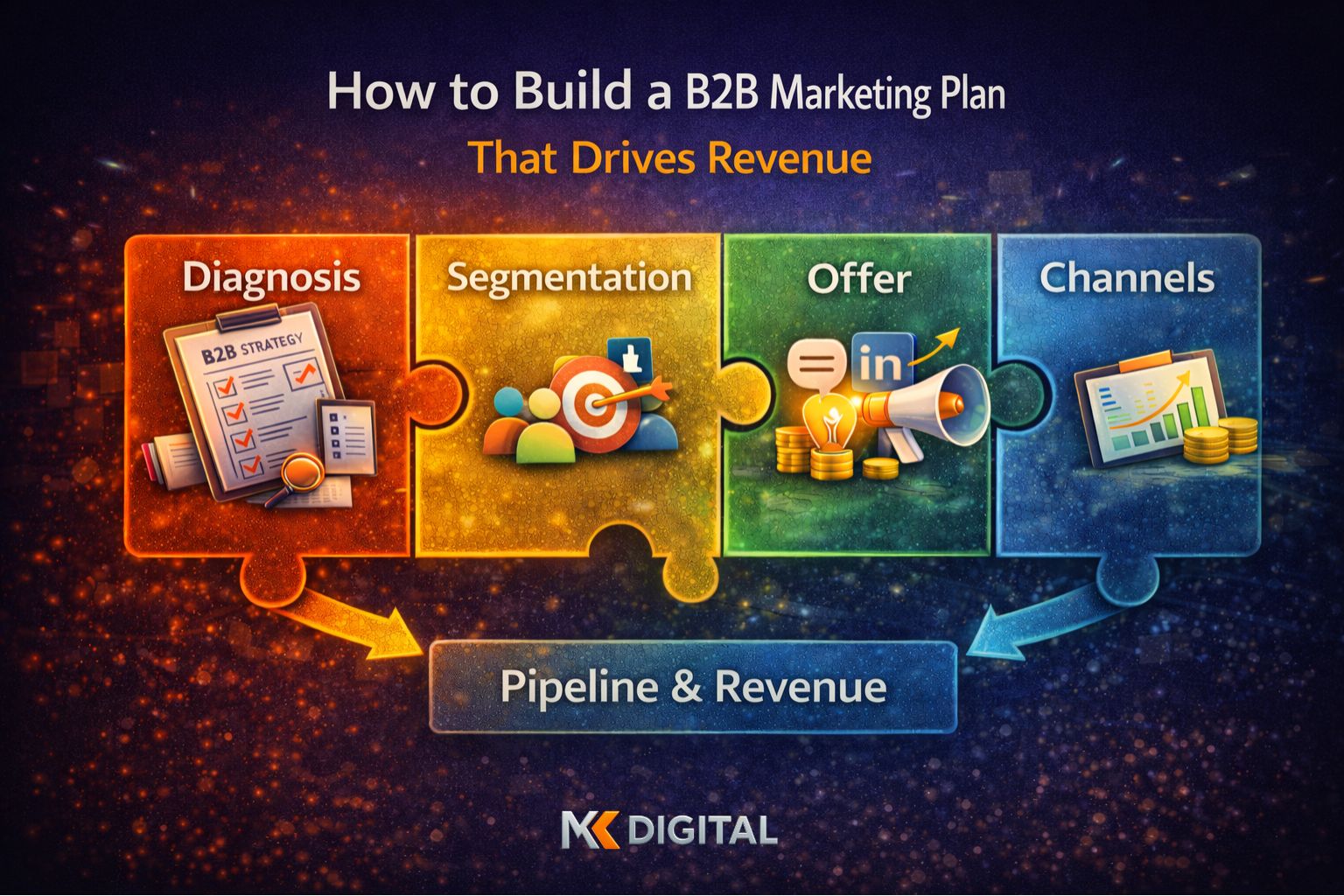
The 5-step framework for a B2B marketing plan that works
Instead of overcomplicating the process, focus on five key steps.
1. Diagnosis (start with reality, not assumptions)
Before you plan anything, you need clarity.
- Where are you now?
- What is working?
- What is blocking growth?
Without diagnosis, every marketing plan becomes guesswork.
👉 Start here: B2B Marketing Diagnosis
2. Segmentation (focus beats reach)
Not every client is your client.
Define:
- your Ideal Customer Profile (ICP)
- key segments
- decision-makers
Because the more precise your targeting is, the more effective your marketing plan becomes.
3. Offer (what actually matters to the client)
Many companies describe what they do.
However, clients care about outcomes.
Your offer should clearly answer:
- what problem you solve
- what result you deliver
- why it matters
Without this clarity, even strong campaigns will underperform.
4. Channels (distribution, not guesswork)
Channels are not the starting point.
They are the consequence of earlier decisions.
Choose channels based on:
- where your clients are
- how they search for solutions
- how they make decisions
👉 Learn how channels support pipeline: B2B Lead Generation
5. Metrics (measure what drives growth)
A strong marketing plan does not focus only on leads.
Instead, it tracks:
- pipeline generated
- conversion rates
- customer acquisition cost (CAC)
- revenue impact
👉 See why CPL is misleading: Cost Per Lead Mistake
Real example: when planning changes results
We often see companies that:
- run multiple campaigns
- invest in tools
- generate leads
However, results remain inconsistent.
Once we introduce a structured B2B marketing plan:
- targeting becomes sharper
- messaging becomes clearer
- sales alignment improves
As a result:
- pipeline grows faster
- sales cycles shorten
- revenue becomes more predictable
The uncomfortable truth
A B2B marketing plan is not about doing more.
It’s about making better decisions.
Because without clear decisions:
- marketing becomes random
- sales becomes reactive
- growth becomes unstable
Conclusion: clarity drives revenue
If you take one thing from this article, remember this:
Plans don’t drive growth.
Clear decisions do.
And a strong B2B marketing plan is simply a system of those decisions.
Start with clarity, not assumptions
If your marketing feels busy, but not effective,
it’s time to rethink your plan.
Start with a B2B Marketing Diagnosis from MK Digital.
We will help you:
- identify what actually blocks growth
- build a clear, revenue-driven plan
- align marketing with sales
No assumptions.
No guesswork.
Just clarity.