Sales and Marketing Alignment: What Ted Lasso Can Teach B2B Companies

This article explains why sales and marketing alignment is one of the most important drivers of B2B growth, pipeline generation and long-term business performance. Through practical examples inspired by Ted Lasso, we explore trust, communication, buyer behaviour and decision-making in industrial and B2B companies.
With Ted Lasso officially returning for a fourth season, it looks like many of us will soon be heading back to AFC Richmond. According to Apple TV, Season 4 is scheduled to debut on 5 August 2026, with Ted returning to Richmond to coach a second-division women’s football team.
Some viewers will come back for the football. Others will return for Rebecca, Roy, Keeley, Beard, the dressing-room chaos, and the comforting belief that a man armed with optimism, biscuits, and alarming confidence around tea can somehow improve almost any situation.
I will probably come back for the barbecue sauce.
If you have watched the show, you know exactly what I mean. Ted’s famous barbecue sauce becomes one of those small running jokes that somehow says much more than it should. Everybody wants to know what makes it special. Everybody assumes there must be a secret ingredient hidden somewhere in the recipe.
„A marketing strategy is a bit like a barbecue. Everybody wants the secret sauce, but someone still has to stand beside the grill.”
Business leaders often think about marketing in exactly the same way.
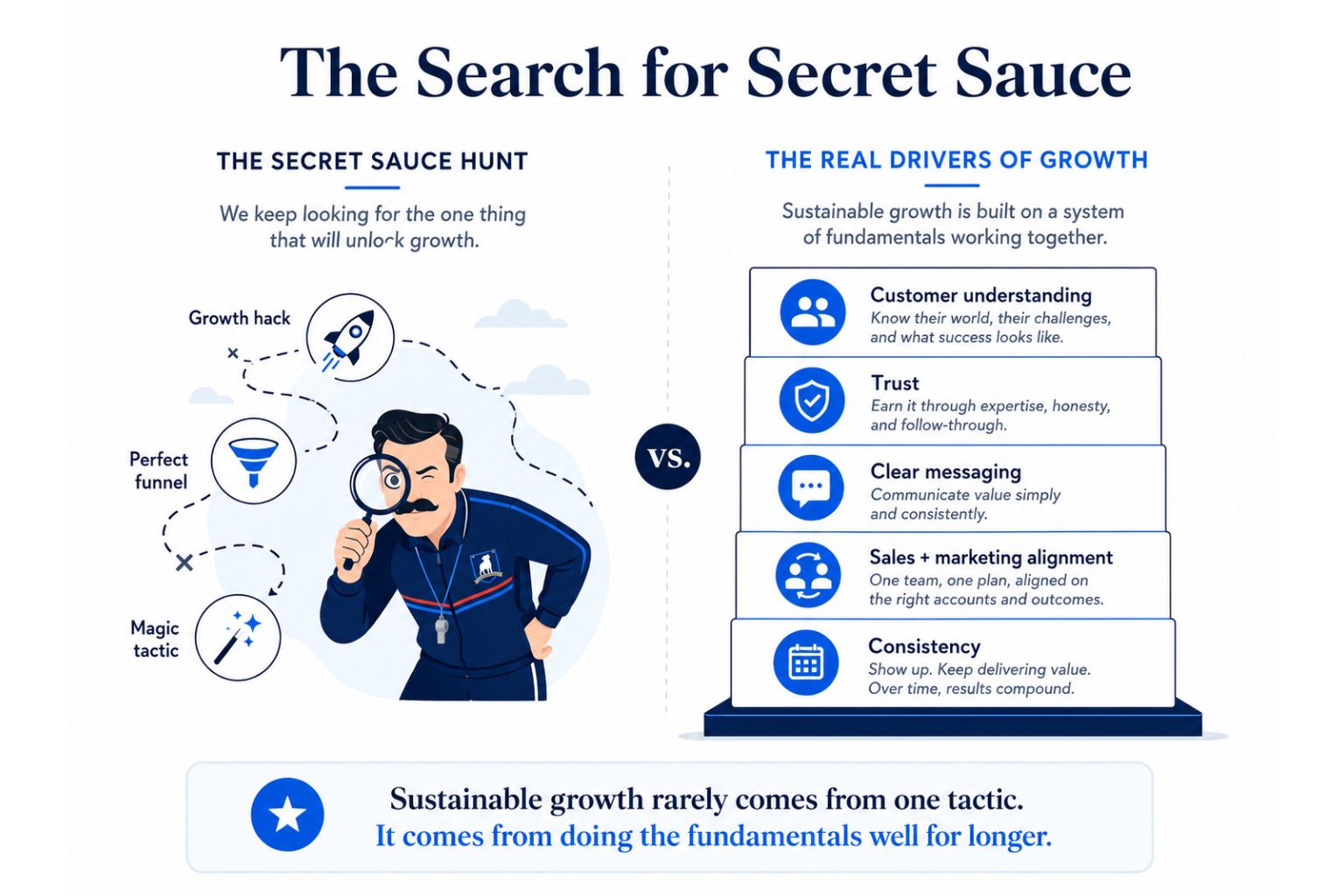
There must be a hidden tactic. There must be a clever funnel, a perfect campaign structure, a magic LinkedIn format, or a secret automation flow that will finally turn attention into revenue. Somewhere, surely, there must be a marketing equivalent of Ted’s barbecue sauce.
And this is where the trouble begins.
Because after years of working with manufacturers, engineering firms, construction suppliers, industrial companies, and B2B organisations, I have become increasingly convinced that sustainable marketing growth rarely comes from discovering a secret ingredient. More often, it comes from doing the fundamental things with unusual consistency, even when the spreadsheet has not yet started clapping.
Not glamorous, I know.
But painfully true.
The meeting every marketer knows
Let me start with a scene that has probably happened in more B2B companies than anyone would like to admit.
A company launches a new marketing initiative. Maybe it is a content strategy. Maybe it is a LinkedIn programme. Maybe it is a thought leadership campaign designed to reposition the business in front of a more strategic audience.
At the beginning, everyone is excited. The plan looks sensible. The target audience is clear. Sales says the topics are relevant. Management nods in the way management nods when they are supportive but already thinking about quarterly numbers.
Then week three arrives.
Somebody opens the analytics report. A few people lean closer to the screen, as if a lead might appear if they stare hard enough. Someone from marketing explains that trust and visibility take time. Someone from sales asks whether any of this has generated „proper conversations” yet.
And then the question lands.
„Okay, but where are the leads?”
At this point the strategy is barely old enough to walk across the office without supervision, but it is already being treated like a failed experiment. It is a bit like going to the gym twice, looking in the mirror, and wondering why you still do not resemble Cristiano Ronaldo.
Ted Lasso would probably smile at that moment, not because results do not matter, but because he understands something many organisations struggle with. Some things need time before they start working.
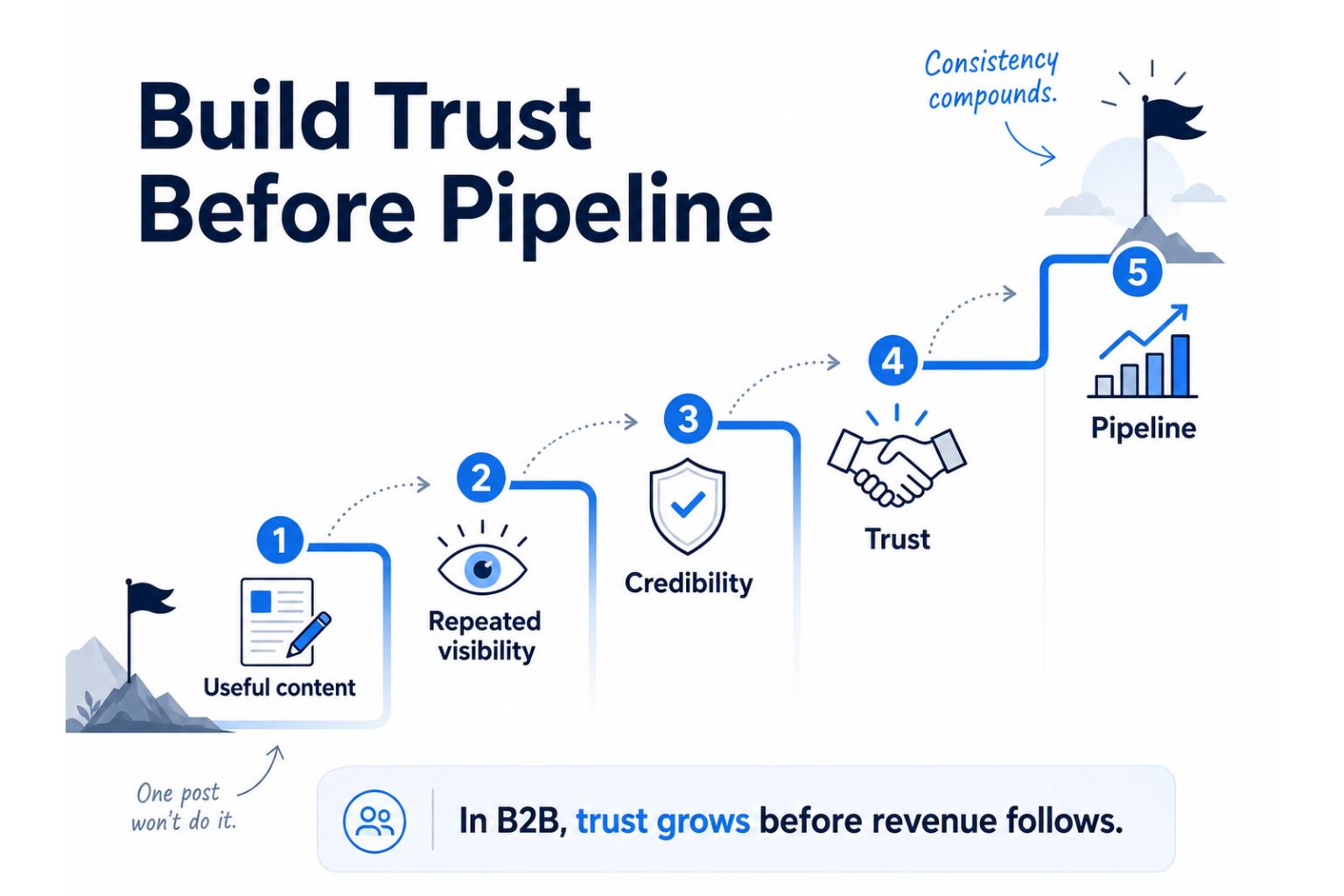
In B2B marketing, trust is not built by one post. Visibility is not created by one campaign. Credibility does not appear because one case study politely walks onto the website and introduces itself.
These assets accumulate. They grow through repeated exposure, useful communication, consistent positioning, and dozens of small moments that slowly make the market think, „I know these people. They understand this problem.”
The challenge is that most organisations want long-term outcomes on short-term schedules. They want thought leadership by next Tuesday, pipeline by the end of the month, and market recognition before the next management meeting. That is not a strategy. That is a microwave with a marketing budget.
Sales and Marketing Alignment Matters More Than Tactics
One of the most tempting ideas in B2B is that poor results can be fixed by better tactics. If leads are down, run another campaign. If the website is quiet, improve SEO. If pipeline is weak, try a new platform, new content format, or new AI tool that promises to turn three vague prompts into a revenue department.
Sometimes those things help. Often, however, they address symptoms rather than causes.
I have seen companies create excellent content that produced very little commercial value because sales and marketing were not aligned. I have seen CRM systems fail after serious investment because nobody agreed what the system was supposed to achieve. I have seen promising strategies abandoned long before the market had enough time to respond.
„I’ve never seen a CRM fix bad communication. That’s like buying running shoes and expecting them to finish the marathon for you.”
In those cases, the problem was not the tool, the campaign, or the content calendar.
The problem was the system around them.
This is where Ted Lasso becomes surprisingly relevant to B2B marketing. Throughout the series, he rarely begins by obsessing over tactics. He focuses first on people, trust, communication, and shared purpose. He understands that performance usually comes from the environment in which people operate.
Marketing works the same way.
A strong strategy inside a poorly aligned organisation will struggle. A good strategy inside a team that trusts each other, understands the customer, and moves in the same direction has a much better chance of producing results.
This is not soft, fluffy leadership talk with a biscuit on top. It is commercial reality.
Understanding the B2B Buyer Journey
Another scene.
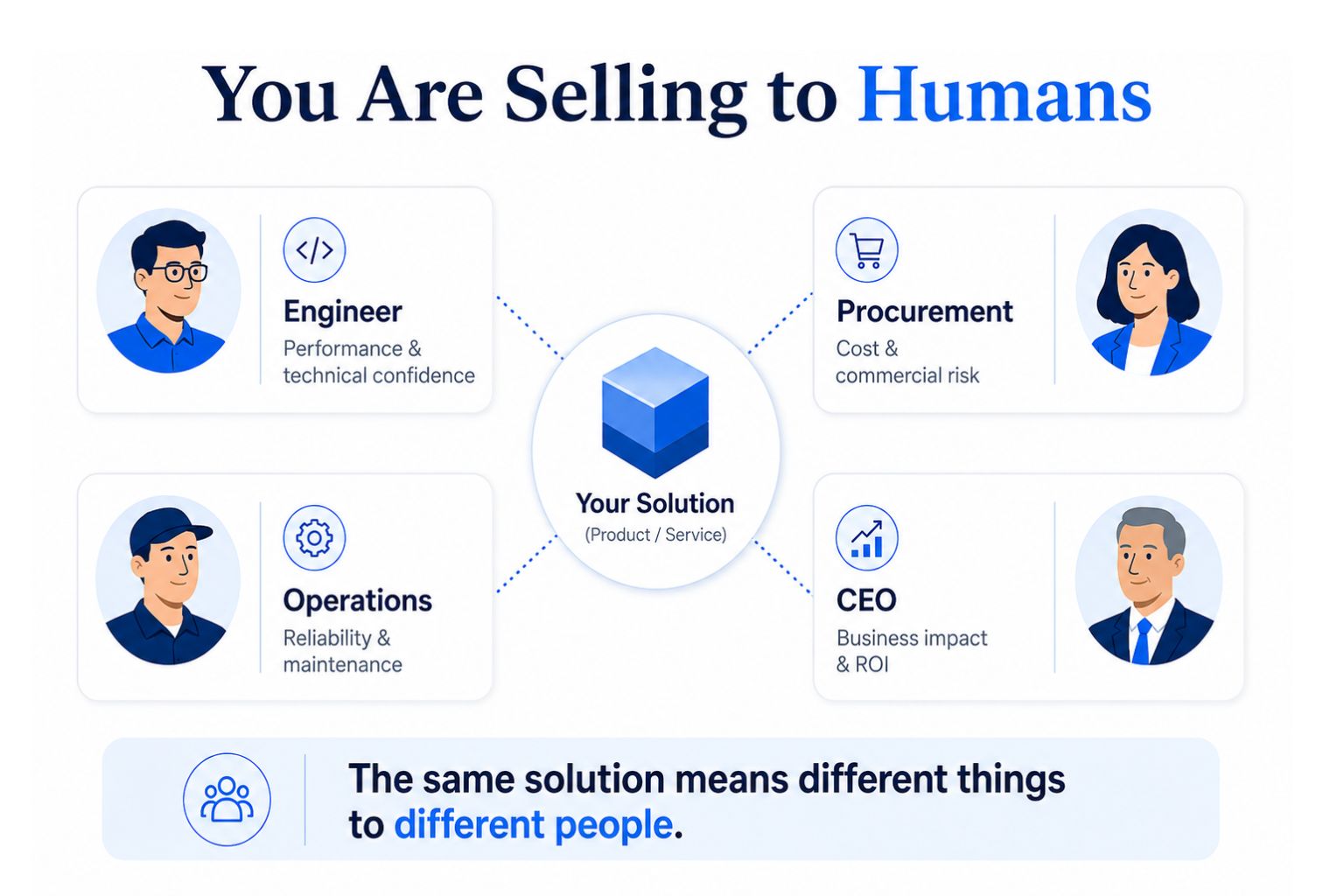
Imagine you are selling a technical product into an industrial business. The engineer likes the performance. Procurement thinks the price needs „reviewing”, which is procurement language for „please remove all joy from this conversation.” Operations wants proof that the solution will not create maintenance headaches later. The CEO wants to know how the investment affects risk, revenue, or efficiency.
Meanwhile, marketing has prepared one brochure designed to speak to all of them at once.
Good luck with that.
One of Ted’s simplest observations is that „all people are different people.” It sounds almost too obvious to be useful, but it explains a lot about B2B buying behaviour.
Companies do not make decisions. People inside companies make decisions. Those people have different pressures, different incentives, different fears, and different definitions of value.
For an engineer, your product may represent technical confidence. For procurement, it may represent commercial risk. For operations, it may represent reliability. For the CEO, it may represent business impact.
The product is the same, but the story changes depending on who is listening.
That is why effective B2B communication does not start with the question, „What do we want to say?” It starts with a better question: „What does this person need to understand in order to make a confident decision?”
That shift sounds small, but it changes everything. It moves marketing away from broadcasting and closer to helping. It also explains why generic messaging fails so often. If everybody receives the same vague message, nobody feels genuinely understood.
And buyers remember whether you understood them.
How Sales and Marketing Alignment Improves Content Creation
There is another very common B2B situation that always makes me smile.
A company says, „We don’t really have enough content.”
Then you speak to sales for twenty minutes and hear five objections customers ask every week. You speak to an engineer and discover a technical explanation that could become an excellent article. You speak to customer service and find patterns in the questions people ask before buying. You speak to operations and uncover a project story that could easily become a strong case study.
By lunchtime, the business that had „no content” suddenly has six months of material.
The problem was never a lack of knowledge. The problem was that nobody had turned everyday expertise into market-facing communication.
„Most content doesn’t fail because it’s bad. Sometimes people just expected it to work faster than a microwave.”
This is one of the biggest missed opportunities in B2B marketing. Valuable insight already exists inside the business, but it is usually scattered across sales calls, technical conversations, project reviews, customer objections, support tickets, and informal knowledge that never leaves someone’s head.
Marketing’s job is not always to invent something new. Often, it is to notice what is already valuable, organise it, and translate it into something buyers can use.
Ted Lasso constantly sees potential where others see problems. Good marketers do the same thing. They look at ordinary conversations and ask, „Could this help a customer understand something better?”
More often than not, the answer is yes.
Honesty is underrated because it is not flashy
One of the reasons Ted Lasso works as a character is that he is honest without being cruel. He tells the truth, but he does not use truth as a weapon.
B2B marketing could use more of that.
Visit enough B2B websites and you may start to suspect there is a secret international agreement requiring every company to describe itself as innovative, customer-focused, trusted, market-leading, and committed to excellence. The wording changes slightly. The meaning rarely does.
„If every company is innovative, customer-focused, and market-leading, then those words have become the participation trophies of B2B marketing.”
The problem is that buyers have seen these phrases so many times they no longer communicate anything meaningful. They do not create differentiation. They create fog.
And B2B buyers already have enough fog in their inbox.
The strongest communication is usually more specific. It explains who the company helps, what problem it solves, where it creates value, and where it may not be the perfect fit. That last part matters more than many businesses realise.
Honesty builds trust because it reduces uncertainty. When a company is willing to say, „This is where we are strong, and this is where we may not be the right choice,” buyers tend to listen more carefully.
The best marketing is not about pushing people into decisions they should not make. It is about helping the right people make the right decision with greater confidence.
Sometimes that leads to a sale now. Sometimes it leads to a relationship that becomes valuable later. Either way, the market remembers companies that behave honestly.
Be optimistic, but not delusional
Ted Lasso’s optimism is not valuable because he ignores reality. It is valuable because he refuses to let reality become an excuse for inaction.
That distinction matters in marketing.
In many B2B companies, pessimism often dresses up as experience. You hear familiar sentences: „Our industry is different.” „Our buyers don’t read content.” „LinkedIn doesn’t work for us.” „We tried that once.” „There is nothing interesting to say.”
Sometimes these objections contain truth. Sometimes they are just fear wearing a blazer.
The optimistic marketer does not ignore difficulty. They simply ask better questions. What if our buyers do not read generic content but would read something genuinely useful? What if LinkedIn did not work because we treated it like a noticeboard? What if the industry is not boring, but we have learned to describe it in the most boring possible way?
Optimism creates movement because it looks for possibilities. Pessimism often creates comfort because it gives people permission not to try.
This does not mean every idea deserves investment. It means a company that never tests anything new eventually becomes very good at explaining why yesterday’s approach should still work tomorrow.
Spoiler: it usually won’t.
Be a goldfish, but keep the lesson
One of Ted’s most famous ideas is to „be a goldfish.” The point is not really about memory, biology, or whether goldfish have hired a good PR agency to exaggerate their emotional resilience. The point is that mistakes should be learned from, not lived inside.
Marketing teams need that advice.
Not every post will work. Not every campaign will deliver. Not every webinar will attract the audience you hoped for. Not every lead will be ready to talk. Sometimes a piece of content you believed in will perform badly, and a simple post you wrote between meetings will somehow bring the best conversation of the month.
Marketing is strange like that.
The danger is not failure. The danger is becoming so afraid of failure that the team stops testing. Once that happens, communication becomes safe, predictable, and gradually invisible.
Good teams review mistakes without building houses inside them. They ask what happened, what can be improved, and what the market may be telling them. Then they move forward.
Be a goldfish.
But maybe keep the notebook.
The real barbecue sauce
So, what is the secret?
This is where people often hope for something more dramatic. A hidden channel. A clever framework. A growth trick that can be implemented before lunch and presented to the board before dinner.
The reality is less theatrical.
The companies that grow consistently usually do the fundamentals better and longer than their competitors. They understand customers more deeply. They align marketing and sales more seriously. They communicate more clearly. They build trust before they need it. They show up consistently, even when competitors get bored and run after the next shiny object.
„The market doesn’t usually reward the loudest company. It rewards the one that keeps showing up after everyone else gets distracted.”
None of this sounds revolutionary, which is exactly why so many companies underestimate it.
Everyone wants the secret sauce. Far fewer want to stand beside the grill for years, testing, improving, listening, learning, and occasionally pretending that the smoke in their eyes is part of the strategy.
But that is usually where the advantage is built.
Not in the one magical tactic.
In the consistent behaviour that the market eventually learns to trust.
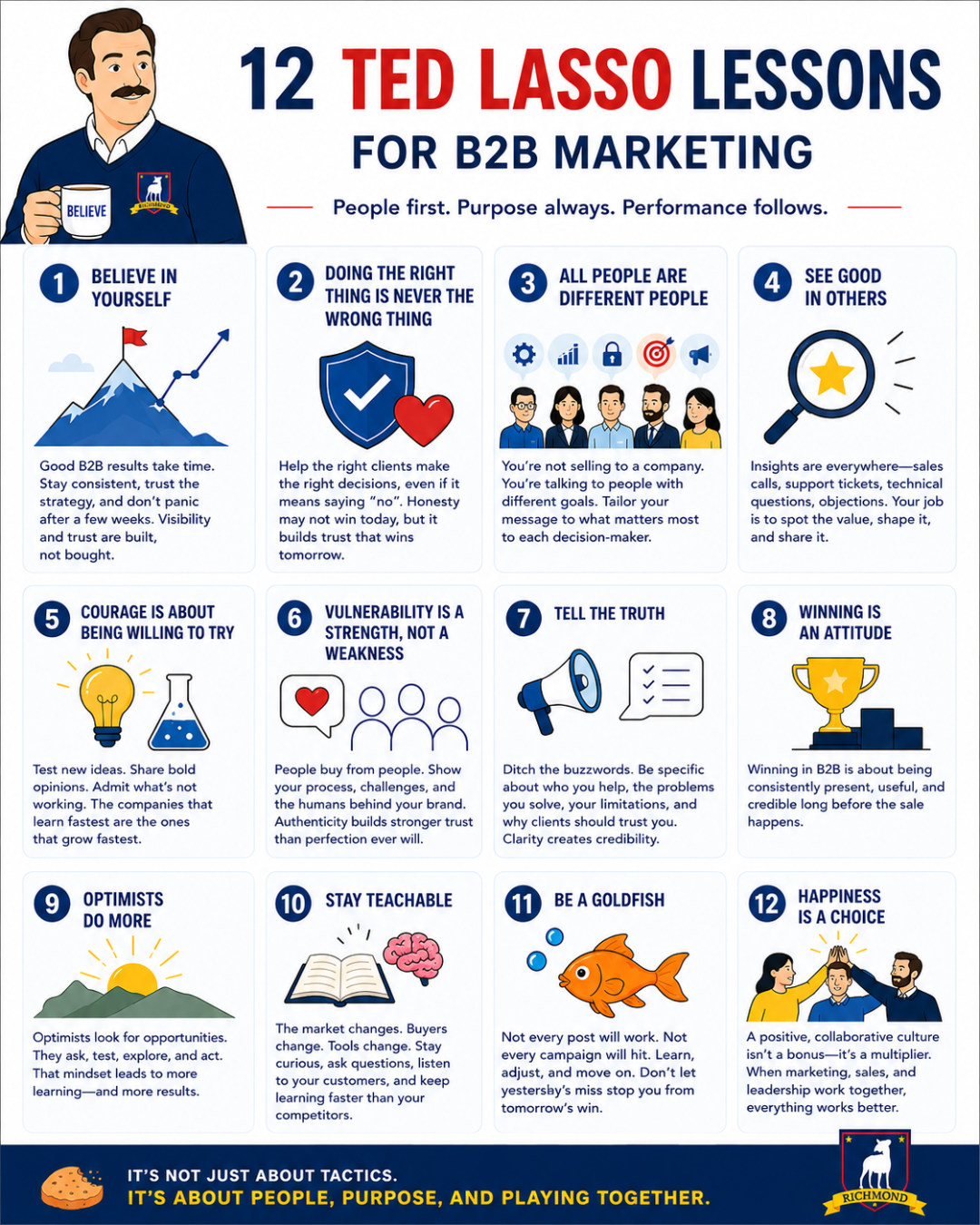
What Ted Lasso would probably ask
If Ted Lasso somehow found himself running a B2B marketing department, I doubt he would begin with attribution models, lead scoring, or a detailed review of LinkedIn impressions.
He would probably ask different questions.
Do marketing and sales trust each other? Do we understand our customers well enough to help them make better decisions? Are we learning from the market, or just defending old assumptions? Are we communicating in a way real people understand? Are we actually playing on the same team?
„If sales and marketing are arguing about lead quality, that’s usually a sign they forgot they’re on the same team. It’s a little like two fishermen fighting over who owns the boat while it quietly sinks.”
Those questions may sound simple, but they sit underneath many marketing problems. When they are ignored, even good tactics struggle. When they are answered honestly, marketing has a much better chance of becoming what it should be: a system for building trust, creating demand, and helping the right customers choose you with confidence.
That may not be as exciting as discovering a secret barbecue sauce.
But it is probably much better for the pipeline.