
Digital Transformation in B2B Marketing
Why industrial companies fall behind
Industrial companies are not resistant to change.
However, they often move slower than the market.
This creates a gap.
Traditional mindset
Many organizations still rely on proven methods.
Trade shows.
Direct relationships.
Referrals.
These channels still work.
However, they no longer cover the full buying journey.
Because clients now research earlier and independently.
Slow adoption
Digital tools are often introduced gradually.
A new website.
A LinkedIn page.
Occasional campaigns.
Although these steps look like progress, they rarely create impact.
Because they are not connected.
Lack of strategy
The biggest issue is not tools.
It is the absence of a clear direction.
Without a strategy, digital efforts remain fragmented.
As a result, companies invest in activity… but do not build growth.
What digital transformation really means
Many companies associate digital transformation with tools.
New platforms.
New software.
New channels.
However, tools alone do not change outcomes.
A real digital transformation in b2b marketing means building a system.
A system that connects:
- targeting
- messaging
- channels
- sales process
Because transformation is not about doing more.
It is about working differently.
The shift in buyer behavior
This is where the biggest change happens.
B2B buyers no longer rely only on sales conversations.
Instead, they:
- search online
- compare suppliers
- evaluate solutions independently
Often before contacting anyone.
Because of that, the decision process starts earlier.
Much earlier.
By the time sales enters the conversation, many decisions are already shaped.
This has a direct impact on strategy.
If your company is not visible during that phase, you are not part of the decision.
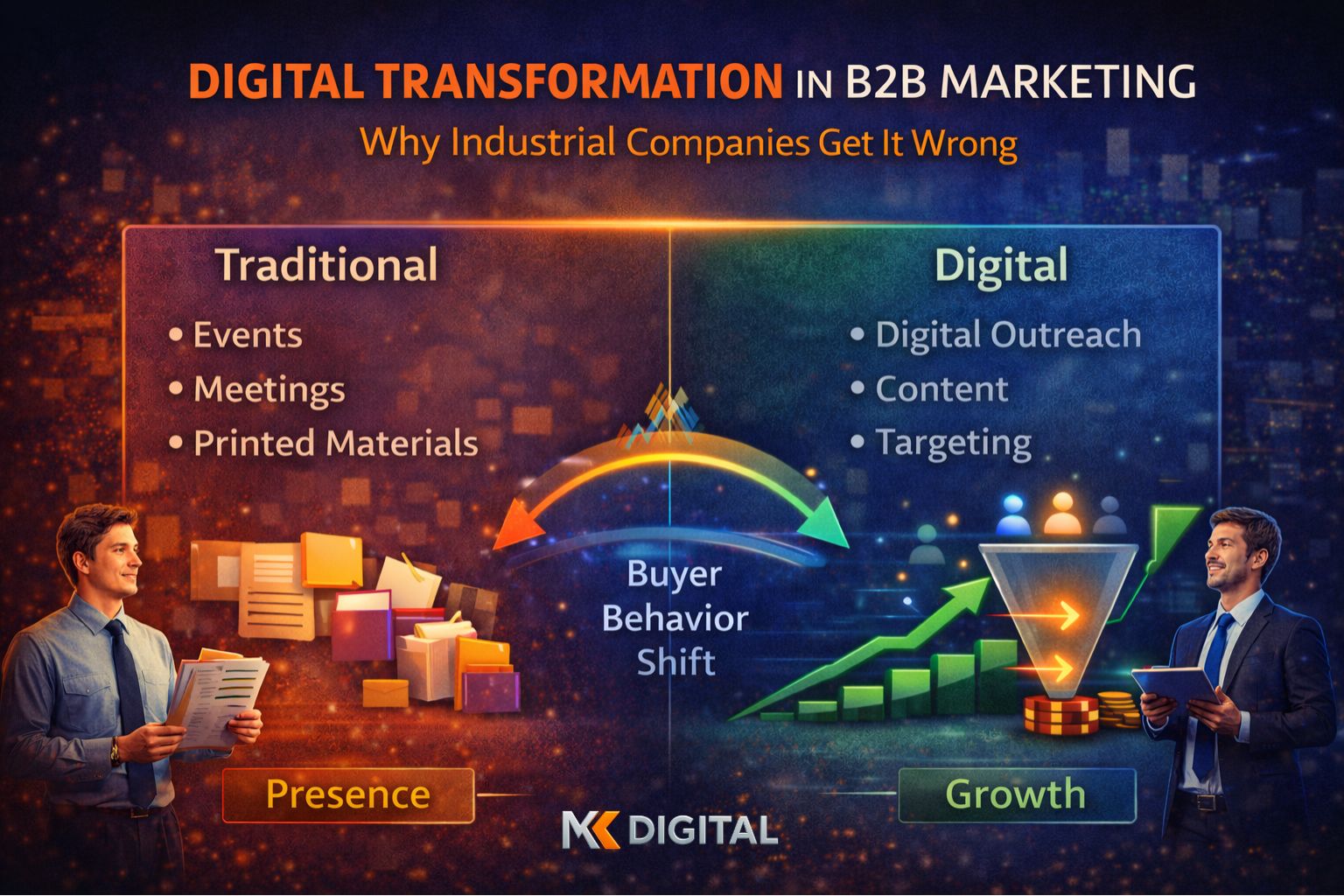
From offline to pipeline
Traditional marketing was focused on presence.
Events.
Meetings.
Printed materials.
Digital marketing shifts the focus to pipeline.
Not visibility.
Not activity.
Pipeline.
A strong digital transformation in b2b marketing connects:
- digital channels
- content
- targeting
- sales engagement
As a result, opportunities are created earlier and more consistently.
👉 Example → [Galco case study]
How to start digital transformation in B2B marketing
You don’t need to transform everything at once.
You need to start with structure.
Step 1: Diagnose your current system
Understand where you are.
What works?
What doesn’t?
Where do you lose opportunities?
Without this step, change is based on assumptions.
Step 2: Define priorities
Focus on what has the highest impact.
- key segments
- most valuable opportunities
- biggest gaps
Because not everything needs to change immediately.
Step 3: Build a connected system
Align:
- marketing activities
- sales process
- communication
Because disconnected actions will not create results.
Step 4: Focus on pipeline, not tools
Tools support the system.
They do not define it.
Measure:
- pipeline growth
- opportunity quality
- conversion
Because these metrics reflect real impact.
The uncomfortable truth
Digital transformation is not about technology.
It is about decisions.
Without a clear system:
- tools do not deliver value
- marketing stays fragmented
- growth remains unpredictable
Conclusion: transformation starts with clarity
If you remember one thing, remember this:
Digital transformation in B2B marketing is not a project.
It is a shift in how your company builds growth.
A strong system connects:
buyer behavior → marketing → sales → pipeline → revenue
Start with clarity
If your digital efforts feel scattered…
and results are inconsistent,
it’s time to take control.
Start with a B2B Marketing Diagnosis from MK Digital.
We will help you:
- understand where your system breaks
- connect marketing with sales
- build a pipeline-driven approach
No assumptions.
No guesswork.
Just clarity.