
B2B Website Conversion: Why Traffic Does Not Become Enquiries

Website traffic is growing. SEO rankings are improving. More people are reading articles, visiting service pages and finding the company through Google. But enquiries remain almost exactly where they were six months ago.
The first reaction is often to ask how to generate even more traffic. More SEO, more content, more LinkedIn activity or a larger paid-media budget should create more opportunities, right?
Not necessarily.
If the right companies already reach your website but rarely take another step, acquisition may not be the main bottleneck. The problem may be B2B website conversion: what happens between someone arriving on the site and deciding that your company is worth investigating further.
In complex B2B, that decision rarely depends on one button or one form. Buyers need to recognise that you understand their problem, see that your company fits their situation, find enough evidence to reduce risk and identify a next step appropriate to where they are in the buying process.
If any of those elements are missing, traffic can grow while enquiries remain flat.
What does B2B website conversion actually mean?
B2B website conversion is the process of turning relevant website visitors into meaningful commercial actions. Depending on the buying stage, that may be a direct enquiry, a request for technical information, a case-study visit, a resource download, a return visit or another signal that moves the buyer closer to a sales conversation.
This matters because not every valuable visitor is ready to contact sales today.
An engineer researching a technical problem may be six months away from a project. A procurement manager comparing potential suppliers may still be building a shortlist. A managing director may be trying to understand whether the problem is important enough to justify investment.
A good B2B website therefore does not simply ask every visitor to Book a Call. It helps different buyers make the next logical decision.
A useful way to think about the journey is:
Right visitor → relevance → understanding → proof → appropriate next step → enquiry
A conversion problem can appear at any of those transitions.
1. You have more traffic, but not more of the right traffic
Before changing the website, establish whether the people arriving there actually resemble the companies you want in the pipeline.
This sounds obvious, but traffic reports can create false confidence. Organic visits may grow because an article ranks for a broad informational query. LinkedIn may create a spike because a post reaches thousands of people outside the target market. Paid campaigns may generate inexpensive clicks from audiences that look attractive in advertising dashboards but have little commercial potential.
From an analytics perspective, all of this is growth. From a pipeline perspective, it may mean very little.
Imagine an industrial company receiving 10,000 monthly visits, but most come from students, job seekers, consumers or businesses far outside its ICP. Another receives only 1,500 visits, but many come from engineers, procurement teams and decision-makers inside target accounts.
The smaller website may have significantly more commercial potential. Before asking why traffic does not convert, therefore, ask whether the traffic should convert.
Look at the queries bringing users to the site, the pages attracting them, geography, company types where identifiable, engagement with commercial pages and eventual movement into the CRM.
If the wrong market is arriving, conversion optimisation begins with targeting rather than buttons.
2. The page does not match the reason the buyer arrived
A visitor searches for something specific. They may want to compare two technical approaches, understand an industry requirement, calculate a cost, check whether a product fits an application or find a supplier capable of delivering a particular service.
Then they land on a page that answers a different question. This mismatch happens frequently when companies optimise for keywords without thinking deeply enough about search intent.
A page may technically contain the right phrase but still fail commercially. Someone searching „hot dip galvanizing corrosion protection C4” expects technical guidance and evidence. Someone searching „hot dip galvanizing company Ireland” is much closer to supplier selection and needs credibility, capacity, location, proof and an obvious way to make contact.
Those visitors should not receive the same experience.
The same applies beyond SEO. A LinkedIn post about a specific operational problem should lead to content that develops that problem, not to a generic homepage. An advert about one application should not send buyers to a catalogue containing twenty unrelated product groups.
Good B2B website conversion begins with continuity:
The promise that earns the click should continue on the page that receives it.
When intent and landing experience are disconnected, the visitor has to work out for themselves whether they are in the right place.
Most will not.
3. Buyers cannot quickly understand why your company is relevant
Industrial and technical companies often underestimate how much internal knowledge they use to interpret their own websites.
Employees already know what the company does, which markets it serves and why customers choose it. New visitors do not.
A homepage saying that the company provides innovative solutions, outstanding quality and excellent customer service may sound professional, but it gives the buyer very little information that helps them decide whether to continue.
The first questions are much simpler:
- What do you actually do?
- Is it relevant to companies like mine?
- Do you understand my problem?
- Why should I continue looking here rather than return to Google?
Clear positioning reduces that cognitive work.
For a specialist B2B business, specificity is usually more useful than corporate language. Industries served, problems solved, applications, geography, project types, technical capabilities and areas of expertise help buyers recognise fit quickly.
The objective is not to explain the entire company above the fold.
It is to give the right buyer enough confidence to think:
„This looks like it could be for us.”
If the visitor cannot reach that conclusion quickly, better traffic will simply create more exits.
4. Your website explains what you sell, but not why the buyer should care
Many B2B websites are organised around the company’s internal structure.
- Products
- Services
- Divisions
- Technologies
- Features
- Specifications.
Buyers often begin somewhere else: with a problem.
They want to reduce downtime, meet a new technical requirement, improve durability, simplify installation, reduce lifecycle cost, increase production capacity or lower project risk.
A product page that explains only what the product is forces buyers to translate features into business meaning themselves. That is especially risky in technical markets because the relationship between specification and value is not always obvious.
Instead of stopping at: „Manufactured from material X and tested to standard Y.”
the content should also help explain: Why does that matter in this application? What risk does it reduce? What alternative does it replace? Under which conditions does the difference become important?
Technical detail and commercial relevance should reinforce each other. The goal is not to simplify technical products until the expertise disappears. It is to make the expertise useful to someone making a decision.
5. There is not enough proof to justify the next step
Your company says it can deliver. The buyer now wants evidence.
This is where many websites move too quickly from promise to CTA. A visitor reads that the supplier is experienced, reliable and technically capable, and the next thing they see is: Contact us today.
The missing layer is proof. Before giving you their time, buyers may want to see projects similar to theirs, recognised customers, technical results, certifications, detailed case studies, named experts, examples of applications, measurable outcomes or evidence that you understand their sector.
In complex B2B, this is not simply about building brand trust. It is about reducing the personal risk associated with taking your company into an internal discussion.
Someone recommending a supplier to colleagues is effectively saying:
„I think these people are worth considering.”
Good evidence makes that recommendation easier.
A strong case study, for example, should not simply say that you delivered a successful project. It should explain the context, problem, constraints, solution and outcome clearly enough for another buyer to recognise similarities with their own situation.
Claims create interest. Proof creates confidence.
Without that confidence, the safest action for the visitor may be to do nothing.
6. Your only CTA requires too much commitment
This is one of the most common B2B website conversion problems. Every page ends with: Book a consultation. Or: Contact our sales team.
Those are perfectly appropriate calls to action for someone actively evaluating suppliers. They are much less appropriate for someone who has only just started researching a problem.
Industrial and technical buying journeys can last months or years. During that time, buyers move through different levels of intent.
Someone early in the journey might want to read a relevant case study or technical guide. Someone comparing approaches may want a detailed comparison or selection guide. Someone validating a supplier may want project examples, certifications or implementation information.
Only later might they want to speak with sales. Your website should therefore offer a ladder of next steps, not a single leap from anonymous visitor to meeting.
That might include:
- read a related case study,
- explore a technical guide,
- compare available approaches,
- download a checklist or planning tool,
- review specifications,
- request technical information,
- ask an expert a question,
- book a diagnosis or sales conversation.
This is not about filling every page with ten buttons.
It is about matching the next action to buyer readiness.
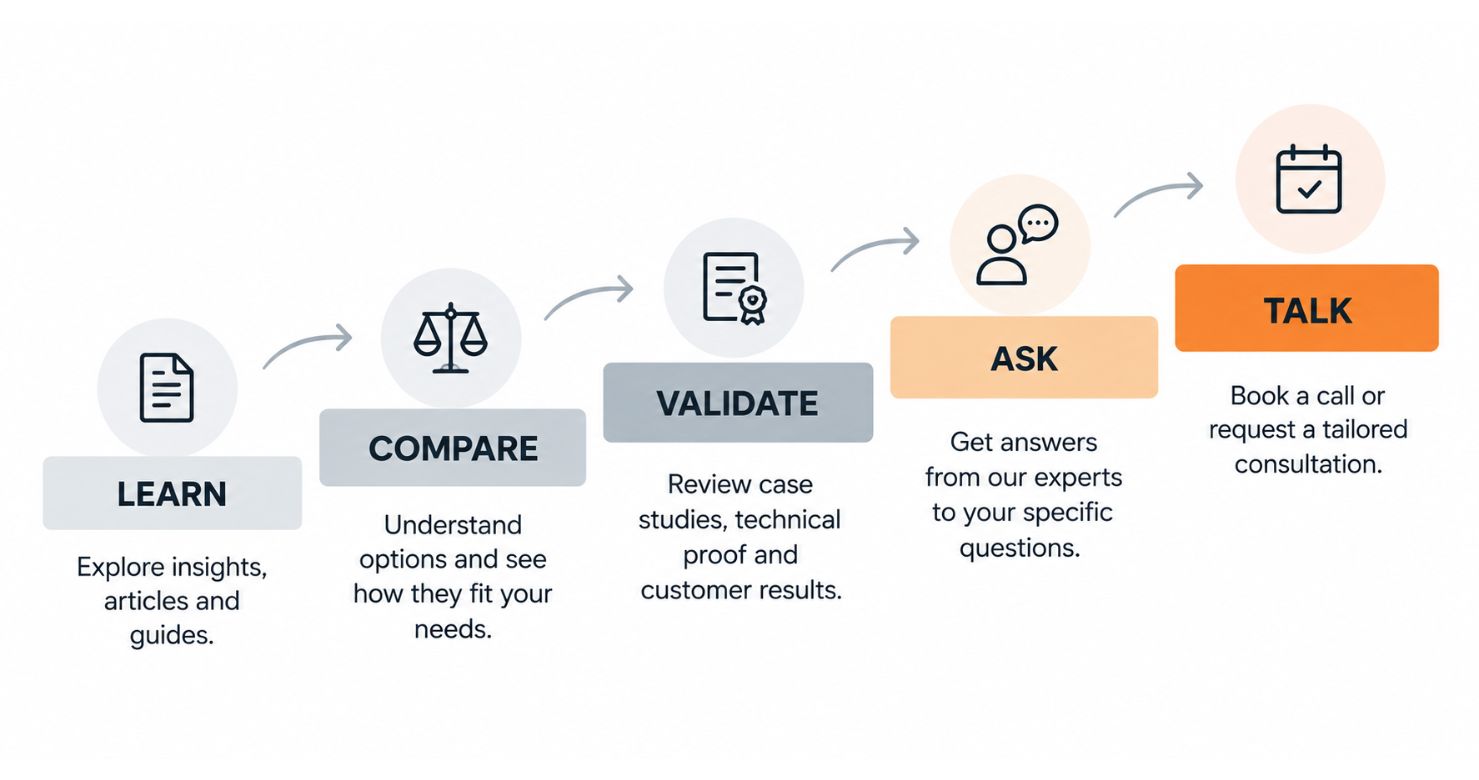
Recommended simple graphic:
Learn → Compare → Validate → Ask → Talk
This works well here because it visually reinforces the idea that conversion is a sequence rather than one final form.
7. Your forms are designed around your CRM, not the buyer
Once a visitor decides to make contact, companies can still lose them. The enquiry form asks for name, company, job title, phone number, email, country, number of employees, revenue, product category, budget, project timeline and a detailed description of requirements.
From the company’s perspective, this information helps qualification. From the visitor’s perspective, they may simply want to ask whether you can solve a problem. Every additional field has a cost.
That does not mean every B2B form should contain only an email address. Some qualification before contact is useful, especially where sales resources are limited or enquiries vary significantly in quality.
The question is whether you need the information now. If sales can obtain it naturally during the next conversation, forcing the buyer to provide it before the conversation may create unnecessary friction.
The form should reflect the value of the action. Requesting a technical drawing may reasonably require more information than downloading an educational guide. Conversion improves when the effort you ask from the buyer matches the value they expect to receive.
8. Buyers reach a page that creates new uncertainty
Websites are often reviewed internally for whether the information is correct. Buyers evaluate them differently. They notice uncertainty.
- Why is there no pricing information at all?
- Does this company work internationally?
- Who actually delivers the service?
- Is this suitable for companies our size?
- What happens after we contact them?
- How long does implementation take?
- Are there minimum order values?
- What happens if the project changes?
Nobody expects every commercial detail to be published online. But when too many obvious questions remain unanswered, contacting sales starts to feel like entering an unknown process.
For many buyers, doing nothing is easier. This is why strong B2B websites increasingly explain not only the offer but also how buying works.
That might mean describing the process, typical project stages, responsibilities, indicative investment ranges, lead times, what happens during the first meeting and who the customer will speak with.
Transparency reduces uncertainty. And reduced uncertainty makes action easier.
9. The website supports one person, while the decision involves several
A technical user may love your website. Procurement may not.
An operations director may understand the benefits but struggle to justify the investment internally. A managing director may never reach the technical content because they are looking for business impact rather than product detail.
Complex B2B purchases involve buying groups, and different stakeholders visit a website with different questions.
The engineer may want performance data and application guidance. Procurement wants supplier credibility, commercial clarity and risk reduction. Management may care about operational impact, lifecycle cost, strategic benefit or the consequence of doing nothing.
If the website speaks convincingly to only one of those groups, your first visitor may still hesitate to make an enquiry because they know the decision will need wider support.
Good content gives the internal champion material they can reuse.
A technical buyer should be able to send a case study to management. Procurement should find information supporting supplier validation. A project lead should be able to share a comparison explaining why one approach is preferable.
Your website is not only selling to the visitor. It is helping the visitor sell the decision internally.
10. You measure conversion as „form submitted” and miss everything before it
Another reason companies struggle to improve B2B website conversion is measurement. Traffic is easy to measure. Form submissions are easy to measure. Everything between those points is less obvious. But that middle layer contains valuable information.
Are visitors from target searches reaching service pages? Do readers of technical articles continue into case studies? Do target accounts return several times? Which pages tend to appear before an enquiry? Do visitors reach pricing or process information before leaving? Which content is consumed by companies that later become opportunities?
No single metric provides the answer. The objective is to understand whether the website is helping relevant buyers move forward.
That may require combining analytics, Search Console, CRM data, form sources, account-level information where available and qualitative conversations with sales.
The website should not be evaluated only as:
Traffic → Form
A more useful model is:
Traffic → Relevant engagement → Buying progress → Signal → Enquiry → Opportunity
This connects website behaviour with commercial reality rather than treating conversion as an isolated marketing statistic.
You can diagnose a B2B website conversion problem by the symptom
The same outcome, too few enquiries, can have very different causes.
A website attracting mostly irrelevant search traffic needs a different solution from one receiving strong commercial traffic but failing to establish trust. A site with excellent proof but one aggressive CTA has a different problem again.
This is why a redesign is not automatically the answer. Changing fonts, colours and layouts can improve usability, but it will not fix poor positioning, weak intent matching, missing evidence or a buyer journey that stops before the customer is ready to talk.
| Symptom | Likely problem | What to investigate first |
|---|---|---|
| Traffic grows but enquiries do not | Traffic quality or weak conversion journey | Queries, ICP fit, landing pages and enquiry paths |
| High traffic, very short visits | Intent mismatch | Does the page answer the question that generated the click? |
| Users visit several pages but rarely contact you | Weak proof or unclear differentiation | Positioning, case studies, evidence and expertise |
| Content performs but service pages do not | Broken buyer journey | Internal links, next-step content and commercial pathways |
| Visitors reach contact pages but do not submit | Too much friction or uncertainty | Form length, process clarity, privacy concerns and expected next step |
| Many downloads, few sales enquiries | No progression from education to buying intent | CTA ladder, nurture and links to BOFU content |
| Enquiries increase but sales rejects most of them | Conversion optimised for volume, not quality | ICP, qualification criteria, source and commercial intent |
How to improve B2B website conversion
Do not start by changing every page. Start with the parts of the website already receiving commercially relevant traffic.
First, identify the pages that attract visitors closest to your ICP or to meaningful buying questions. Then examine what the buyer sees when they arrive. Is the intent matched? Is the positioning clear? Does the page answer the real decision question rather than simply describing a product?
Next, look for evidence. Can the buyer verify the claims through case studies, technical proof, results or relevant expertise? Then review the available next step. Does it match the visitor’s likely stage of the journey?
Finally, connect the website to pipeline data. Which pages and journeys appear most often before qualified enquiries and opportunities? Which generate traffic but almost no commercial movement?
This produces a much more useful optimisation cycle:
Intent → Page → Proof → Next step → Enquiry → Pipeline → Learning
The objective is not a universally higher conversion rate. It is more of the right companies moving towards meaningful commercial conversations.
A higher conversion rate is not always better
This point is easy to miss. Imagine you simplify every form, add aggressive pop-ups and create several high-pressure calls to action. Enquiry volume doubles.
But sales now spends more time filtering students, tiny companies, irrelevant requests and prospects with no realistic fit.
Technically, website conversion improved. Commercially, the system may have become worse. This is why B2B website conversion should be connected to lead quality and pipeline.
A useful hierarchy is:
Enquiries → Qualified enquiries → SQLs → Opportunities → Pipeline
An increase at the first stage matters only if enough of that value survives further down the funnel. The target is therefore not maximum conversion. It is commercially useful conversion.
Do not buy more traffic for a journey that already loses buyers
Traffic is valuable when the website knows what to do with it. If relevant buyers already arrive but struggle to understand the offer, find proof or identify an appropriate next step, more acquisition simply sends additional people into the same broken journey.
That is why traffic growth and conversion optimisation should not be treated as separate marketing projects.
- SEO creates an opportunity.
- The website has to convert that opportunity into progress.
- And the rest of the marketing and sales system has to convert that progress into pipeline.
Before investing in another wave of acquisition, ask:
Are we short of visitors or are we losing the right visitors we already have?
The answer determines whether the next euro should go into generating more demand or fixing what happens after demand reaches the website.
Frequently Asked Questions about B2B website conversion
What is B2B website conversion?
B2B website conversion is the process of moving relevant website visitors towards meaningful commercial action. This may include an enquiry, request for information, resource download, technical interaction or another step that brings the buyer closer to a qualified sales conversation. The right conversion depends on the visitor’s stage in the buying journey.
Why does B2B website traffic not generate enquiries?
Common reasons include irrelevant traffic, poor search-intent matching, unclear positioning, weak proof, content focused on products rather than buyer problems, inappropriate calls to action and too much friction around contact. The first step is to identify which of these problems is actually limiting conversion rather than automatically trying to increase traffic.
What is a good B2B website conversion rate?
There is no universal B2B website conversion rate that is meaningful across every company. Conversion depends on traffic source, market, offer, buying cycle, CTA and how the business defines a conversion. A lower volume of highly qualified enquiries can be much more valuable than a high conversion rate producing poor-fit leads.
Should every website visitor be encouraged to contact sales?
No. In long and complex B2B buying journeys, many valuable visitors are not yet ready for a sales conversation. The website should provide next steps appropriate to different stages, such as technical content, comparisons, case studies, tools, specifications and eventually direct contact.
How can a B2B website generate more enquiries?
Start by improving the journey for relevant visitors already arriving on the website. Clarify positioning, match pages to buyer intent, explain the commercial meaning of technical information, add credible proof and provide appropriate calls to action. Then measure whether those changes improve qualified enquiries and pipeline, not only form submissions.
Does SEO traffic automatically create B2B leads?
No. SEO creates visibility and brings potential buyers to the website, but traffic converts only when the right audience reaches content that matches its intent and helps it move towards a decision. SEO performance should therefore be connected to buyer journey, conversion, lead quality and pipeline.