What Hamilton and Burr Can Teach Us About B2B Marketing

Marketing decision making is one of the most important factors influencing business growth. The story of Hamilton and Burr offers a surprisingly powerful lesson about how organisations approach decisions, risk, execution, and long-term success.
One of the reasons Hamilton became such a cultural phenomenon is that beneath the music, politics, and drama lies a surprisingly timeless story about human behaviour.
At its core, the musical is built around two men who represent opposite approaches to life.
Alexander Hamilton believes action creates opportunity. He refuses to wait for permission, refuses to wait for perfect conditions, and refuses to let fear dictate his decisions. His philosophy is simple: if an opportunity appears, take it. If a door is closed, find a way through it. If nobody is listening, speak louder.
Aaron Burr sees the world differently. He values patience, caution, and timing. Rather than forcing events, he prefers to observe them. Rather than making a move too early, he waits until the risks are lower and the outcome becomes more predictable.
Neither philosophy is inherently wrong.
The tragedy of the story is that both men eventually become prisoners of their own strengths. Hamilton becomes incapable of slowing down, while Burr becomes incapable of moving forward. One runs toward every opportunity. The other waits so long that opportunities begin to disappear.
As I rewatched parts of the musical recently, it struck me how often the same tension appears in B2B marketing.
Most companies are not struggling because they lack ideas. They are struggling because they cannot find the right balance between action and patience.
Marketing Decision Making and the Hamilton Trap
Hamilton’s defining characteristic is not intelligence, although he certainly has plenty of that. It is momentum.
Throughout the story, he is constantly writing, building, debating, launching, persuading, and creating. He seems incapable of standing still. Every challenge becomes a problem to solve. Every opportunity becomes a chance to move forward. Every setback becomes fuel for the next effort.
At first glance, this sounds like the ideal mindset for business growth.
After all, most companies would benefit from more initiative, more energy, and more willingness to act.
The problem emerges when action becomes disconnected from direction.
I have seen many marketing teams fall into exactly the same pattern. When pipeline slows down, the instinctive response is to do more. More content. More campaigns. More webinars. More advertising. More social media activity. More events.
Everyone becomes busier.
The calendar fills up.
Reports become longer.
Meetings become more frequent.
From the outside, it feels like progress.
Yet six months later, the business is often asking the same question:
„If we’re doing so much, why aren’t we growing faster?”
The answer is uncomfortable because activity feels productive. It gives the impression that something is happening. Unfortunately, movement and progress are not the same thing.
Hamilton’s greatest weakness was not that he acted too much. It was that he sometimes acted without considering the long-term consequences of those actions. His relentless drive helped him build a career, shape a nation, and leave a remarkable legacy. It also contributed to personal scandals, political conflicts, and ultimately his downfall.
Businesses experience a similar problem when they confuse momentum with strategy. Running faster only helps if you’re moving in the right direction.
Marketing Decision Making and the Burr Trap
If Hamilton represents action, Burr represents caution.
Throughout much of the story, Burr appears thoughtful, measured, and strategic. He rarely rushes into decisions. He avoids unnecessary risks and prefers to gather information before committing to a course of action.
In many situations, these qualities are incredibly valuable.
Most expensive business mistakes happen because somebody acted too quickly. Companies launch products without validating demand. They invest in marketing channels they don’t understand. They implement technology before defining the process it is supposed to support. They rush into decisions because action feels better than uncertainty.
A little more Burr would save many organisations from making these mistakes.
The challenge arises when caution stops being a decision-making tool and becomes a permanent operating system.
At that point, patience quietly transforms into avoidance.
The website redesign waits for another round of feedback.
The CRM project gets pushed into the next quarter.
The content strategy is delayed until more research is completed.
The LinkedIn programme remains stuck in planning mode because leadership wants greater certainty.
None of these delays feel dramatic in isolation.
In fact, they often feel responsible.
The problem is that markets do not pause while companies continue their internal discussions.
Competitors keep moving.
Buyers keep changing.
Technology keeps evolving.
Opportunities continue to appear and disappear.
While Burr spends much of the musical waiting for the perfect moment, Hamilton is busy shaping events around him. By the time Burr finally decides to act, he often finds himself reacting to circumstances created by someone else.
Many companies unknowingly put themselves in exactly the same position.
Why Marketing Decision Making Often Fails
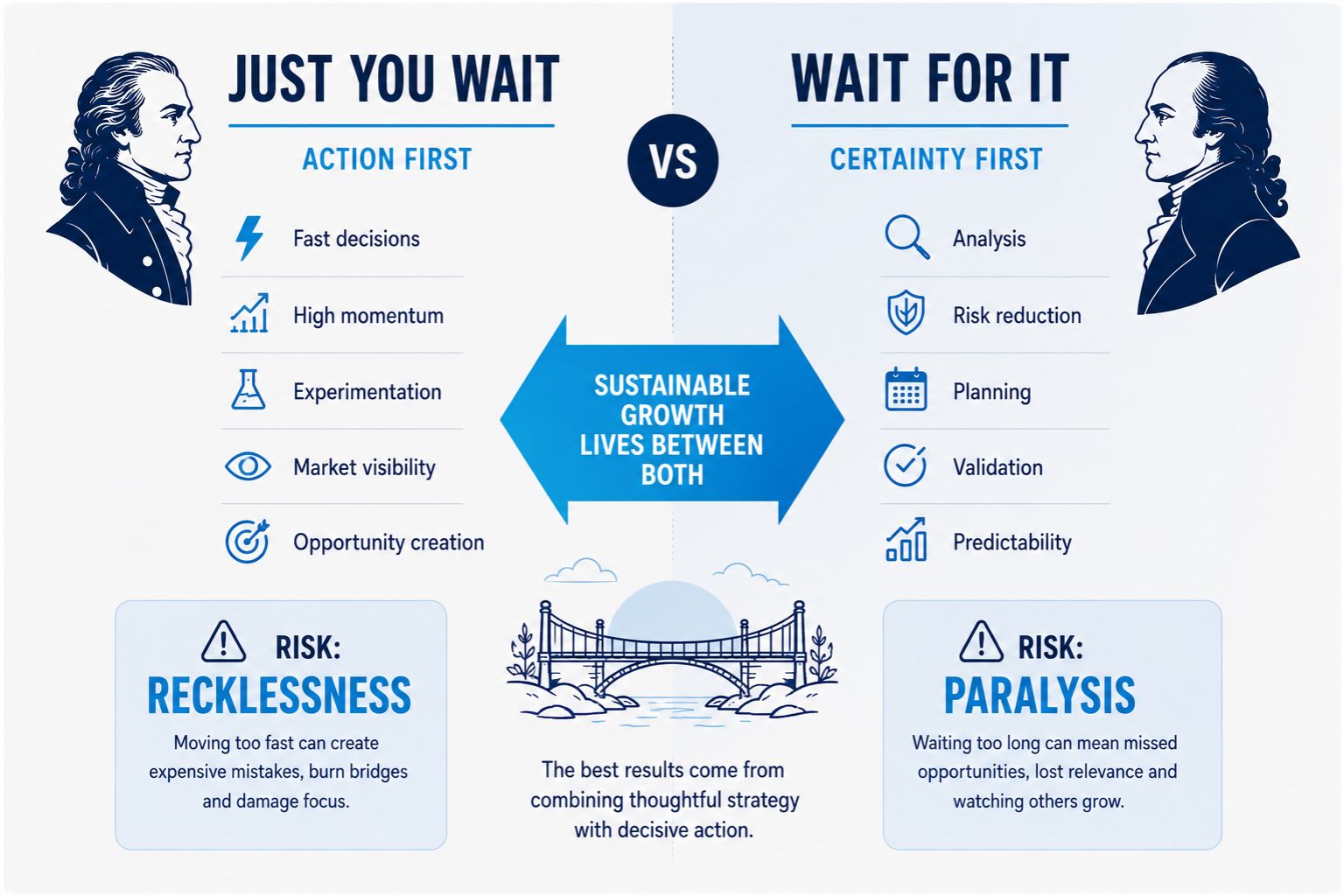
What makes this challenge particularly interesting is that most businesses are not permanently Hamilton or permanently Burr.
Instead, they oscillate between the two.
One quarter they launch multiple initiatives at once, convinced that more activity will solve their growth challenges. The next quarter they become paralysed by analysis after some of those initiatives fail to deliver immediate results.
One year they chase every opportunity.
The following year they become obsessed with reducing risk.
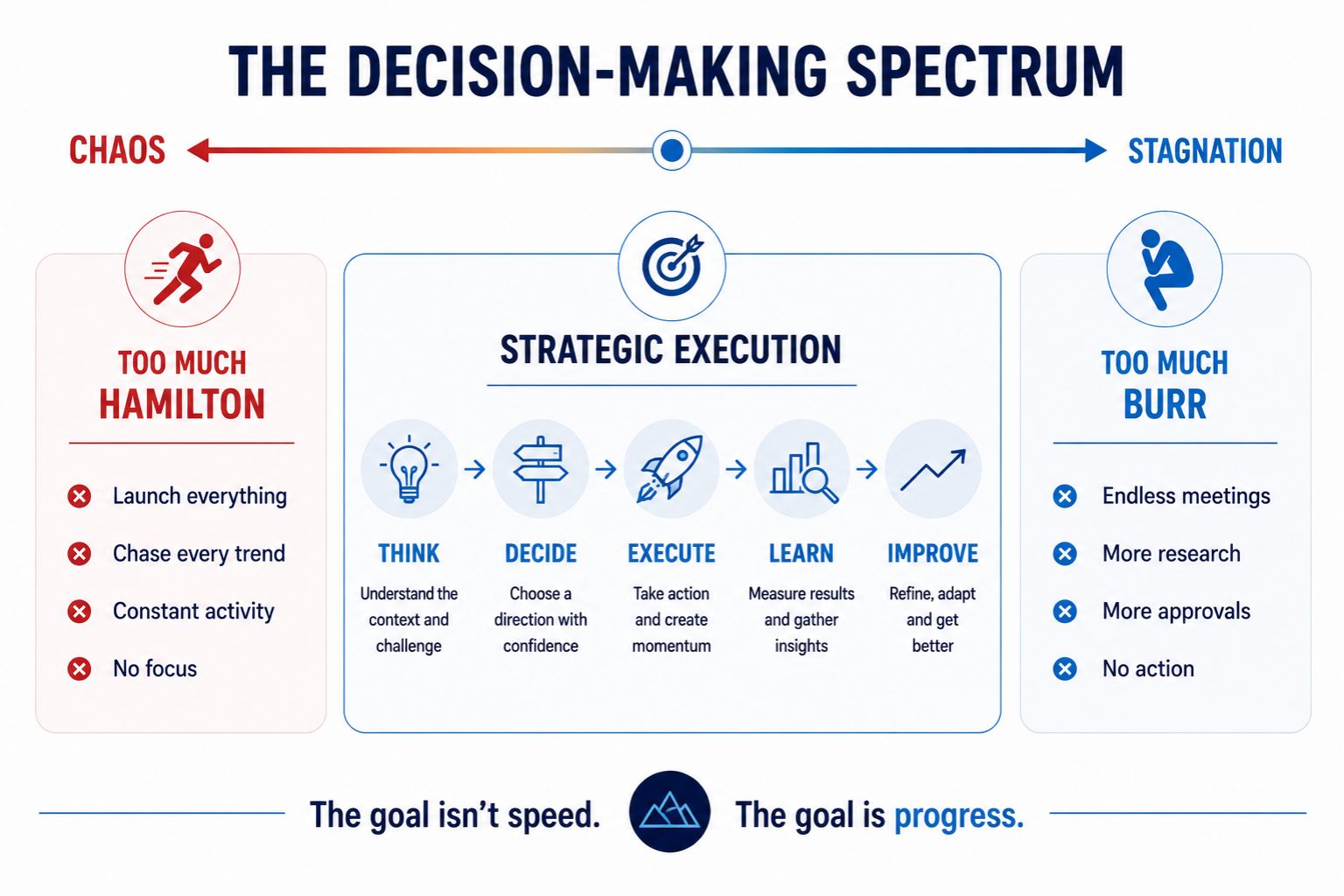
The result is a cycle of overreaction.
Periods of frantic activity are followed by periods of excessive caution. Neither approach creates sustainable growth because neither approach is built around a repeatable system.
Successful marketing rarely comes from random bursts of energy.
It also rarely comes from endless preparation.
Instead, it emerges from disciplined execution supported by clear decision-making.
That sounds simple enough, yet it is surprisingly uncommon in practice.
Why This Challenge Is Especially Dangerous in B2B Marketing
The tension between action and patience exists in every business, but it becomes particularly problematic in B2B environments.
One of the reasons is that results often take much longer to appear.
In consumer marketing, feedback loops can be relatively short. A campaign launches on Monday and sales increase by Friday. The relationship between effort and outcome is often visible.
B2B marketing works differently.
A technical article published today may influence a buying decision twelve months from now. A case study might help justify a recommendation eighteen months later. A LinkedIn post could start a conversation that eventually becomes a commercial opportunity two years down the line.
This delay creates anxiety.
When results do not appear quickly enough, organisations often become more Hamilton-like. They increase activity because they assume more effort will create faster outcomes.
When previous initiatives fail to generate immediate returns, they become more Burr-like. Budgets tighten, projects slow down, and every new idea faces increasing levels of scrutiny.
Ironically, both reactions are driven by the same underlying emotion.
Fear.
Hamilton fears being forgotten.
Burr fears being wrong.
Marketing teams experience remarkably similar pressures.
Some fear missing opportunities.
Others fear making mistakes.
Neither fear creates particularly good decisions.
What Hamilton Understood About Growth
For all his flaws, Hamilton understood something that remains highly relevant for modern businesses.
Opportunities rarely arrive wrapped in certainty.
Markets evolve before the data becomes obvious. Buyer behaviour changes before reports confirm it. New channels emerge before best practices exist.
Companies that consistently grow are rarely those waiting for complete certainty. More often, they are organisations willing to make informed decisions before every variable is known.
That does not mean acting recklessly.
It means recognising that learning often requires movement.
- A content strategy improves because content is published.
- A LinkedIn programme becomes effective because it is tested and refined.
- A CRM implementation succeeds because people start using it and learning from the process.
Action creates information.
Waiting for perfect information rarely does.
What Burr Understood About Sustainability
At the same time, Burr understood something Hamilton frequently ignored.
Not every opportunity deserves pursuit. Not every trend deserves attention. Not every idea deserves investment.
One of the biggest challenges facing modern marketers is the constant pressure to chase the next shiny object. New platforms appear. New technologies emerge. New tactics promise transformational results.
Without discipline, businesses can quickly become trapped in a cycle of constant experimentation with very little strategic focus.
This is where Burr’s perspective becomes valuable.
- Research matters.
- Preparation matters.
- Understanding buyers matters.
- Building systems matters.
The strongest companies rarely succeed because they move the fastest. They succeed because they combine thoughtful planning with consistent execution.
Effective Marketing Decision Making Requires Balance
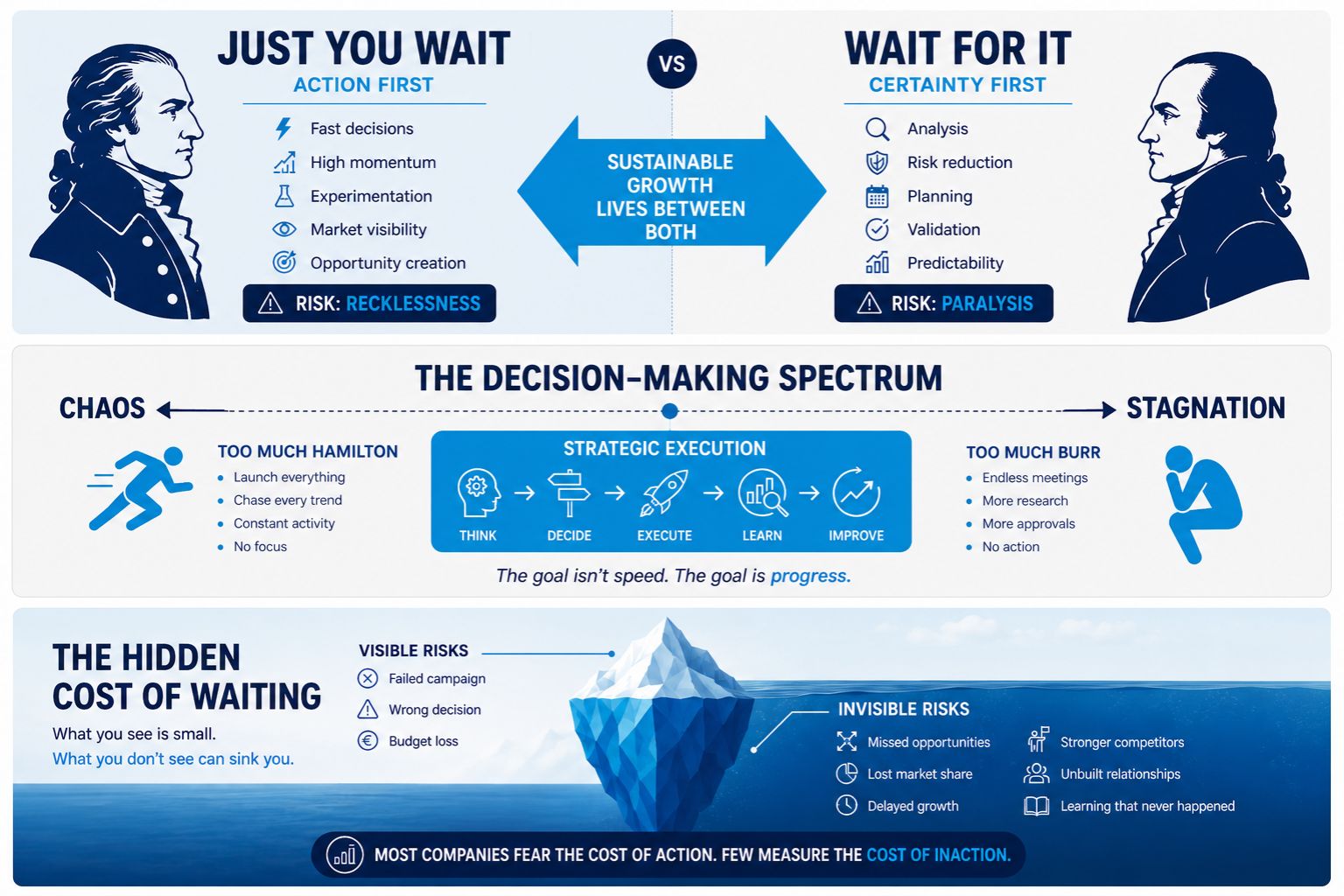
The lesson of Hamilton and Burr is not that one was right and the other was wrong. The lesson is that both eventually allowed their strengths to become weaknesses.
Hamilton’s courage evolved into recklessness.
Burr’s patience evolved into paralysis.
The best marketing teams avoid both traps.
They think before they act, but they also recognise when thinking has stopped being productive. They gather evidence, make decisions, learn from results, and adjust accordingly. They do not launch every initiative that crosses their desk, but neither do they wait forever for certainty that will never arrive.
Most importantly, they understand that marketing is not a choice between speed and caution.
It is a process of balancing both.
The Most Dangerous Decision Is Often No Decision
One of the most powerful themes running through Hamilton is that neither character escapes the consequences of his choices.
Hamilton pays a price for acting too often.
Burr pays a price for waiting too long.
Business works in much the same way.
Not every marketing initiative will succeed. Some campaigns will underperform. Some strategic decisions will prove incorrect. Some investments will fail to deliver the expected return.
Those risks are unavoidable.
What many organisations fail to recognise is that inaction carries risks as well.
- Opportunities disappear.
- Markets evolve.
- Competitors gain ground.
- Buyer expectations change.
Unlike failed campaigns, these losses rarely appear on a dashboard. They simply become opportunities that never existed because nobody acted when action was required.
That is why the most dangerous decision is often not the wrong decision.
It is the decision that never gets made.
Finding Your Own Balance
Most businesses do not need more Hamilton.
They also do not need more Burr.
What they need is the ability to borrow the best qualities from both.
They need enough Hamilton to create momentum, pursue opportunities, and take action before perfect certainty arrives. At the same time, they need enough Burr to evaluate risks, think strategically, and avoid becoming distracted by every new possibility.
Sustainable growth rarely comes from reckless action.
It rarely comes from endless patience either.
Instead, it comes from understanding when to wait, when to move, and when the pursuit of certainty has become a substitute for progress.
Because in business, just as in Hamilton, the future rarely belongs to those who rush blindly forward or those who wait forever on the sidelines.
More often, it belongs to those who know the difference between preparation and procrastination, and have the courage to act when the moment arrives.
Strong marketing decision making helps organisations balance strategy and execution, avoid costly mistakes, and create sustainable growth. In many cases, the difference between success and failure is not the quality of the idea, but the quality of the decisions behind it.
So, what about you?
Are you team „Just you wait” or team „Wait for it”?