Why B2B Lead Generation Is Getting Harder

Why B2B lead generation is getting harder is one of the most common questions B2B companies ask today.
A few years ago, B2B marketing felt surprisingly predictable…
Perhaps not easy. But predictable.
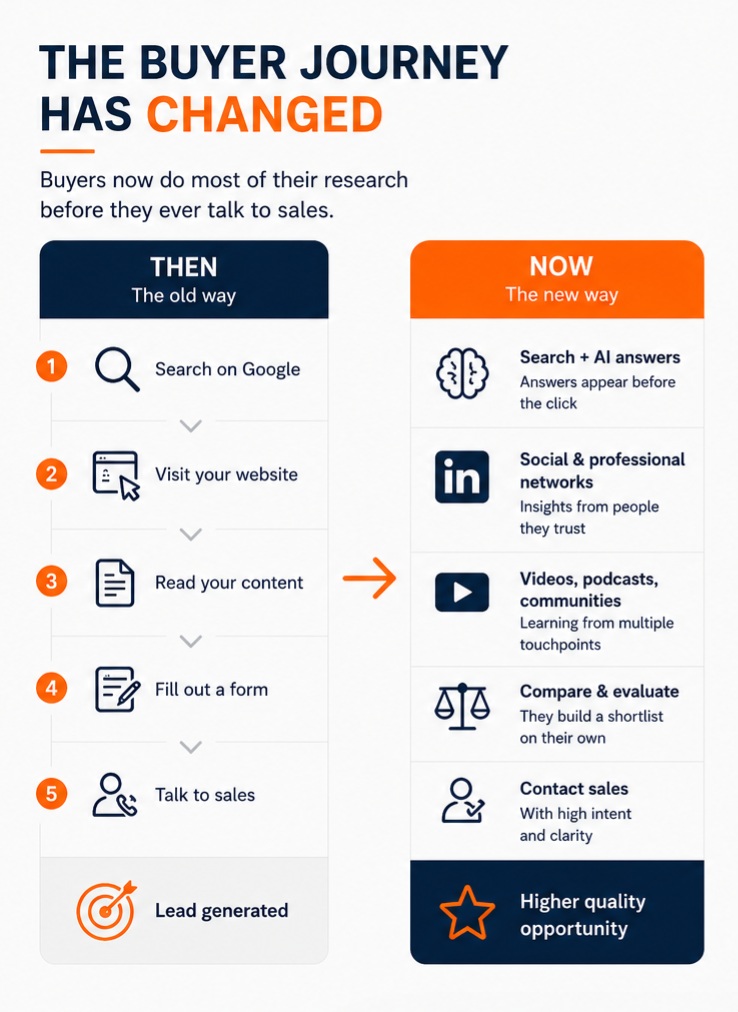
A potential customer identified a problem, searched for a solution, visited a website, consumed a piece of content, filled out a form, and eventually spoke with sales. That process powered countless marketing strategies, generated millions of leads, and helped businesses of all sizes build predictable growth.
For nearly two decades, it worked remarkably well.
Then something changed.
Over the past twelve months, I’ve had more conversations about declining lead generation than at any other point in recent years. Companies are still investing in marketing. They’re still publishing content, running campaigns, attending trade shows, and improving their websites.
Yet many of them are generating significantly fewer qualified opportunities than they were a year ago.
Based on what we’re seeing across client projects, industrial businesses, and our own campaigns, meaningful B2B enquiries appear to have declined by roughly 20% year-over-year.
That doesn’t mean demand has disappeared.
It doesn’t mean marketing has stopped working.
It means buyers have changed their behaviour, while many businesses are still relying on a playbook designed for a different market.
Why B2B Lead Generation Is Getting Harder
Whenever lead volume starts to fall, businesses often assume demand is shrinking. It’s a natural conclusion, but in many cases it’s wrong.
The demand is still there.
What’s changing is how buyers discover information, evaluate suppliers, and make decisions.
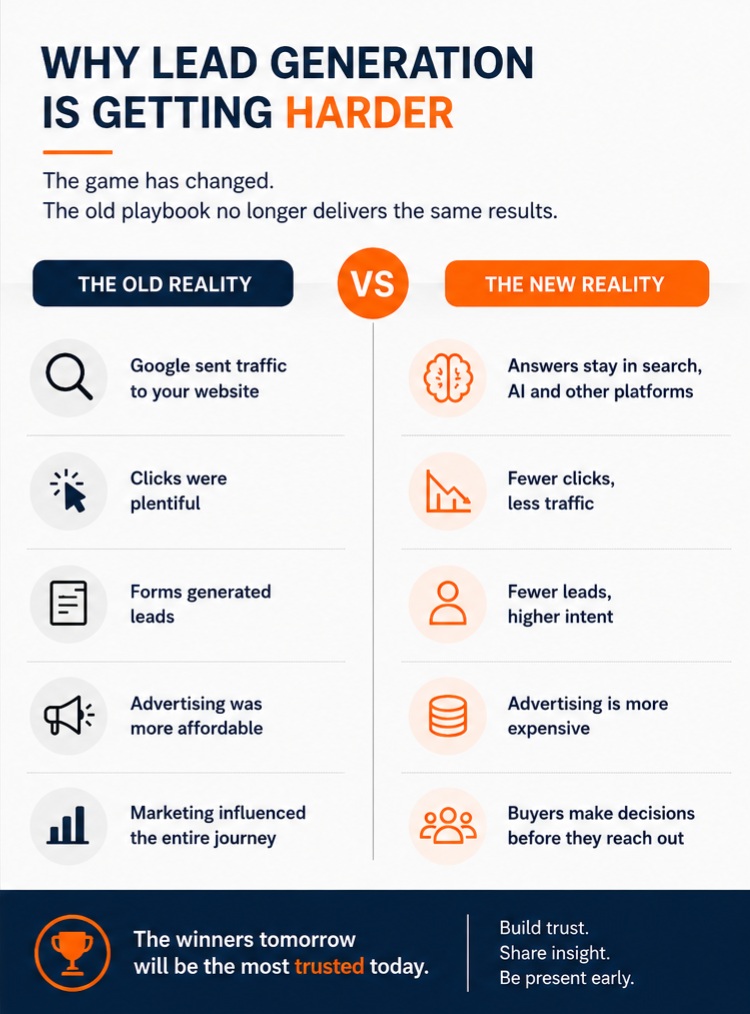
For years, Google acted as the primary gateway between businesses and potential customers. Someone searched for an answer, Google sent them to your website, and your website did the job of educating and persuading.
Today, that journey looks very different.
Search results increasingly provide answers before a user ever clicks a link. AI-generated summaries condense information from multiple sources into a single response. Prospective buyers are gathering insights from LinkedIn posts, podcasts, YouTube videos, industry communities, peer recommendations, and AI platforms long before they visit a supplier’s website.
As a result, website traffic is becoming a less reliable indicator of market demand.
Fewer visitors don’t necessarily mean fewer buyers.
More often, it means buyers are completing a larger portion of their research elsewhere.
Why Traditional B2B Lead Generation Is Becoming Less Effective
When lead volume drops, many businesses instinctively increase their advertising spend.
Sometimes that works.
More often, it simply masks a deeper problem.
Advertising costs have been rising steadily for years. Competition continues to increase across nearly every channel, while buyers become more selective about where they invest their attention.
The result is that many companies find themselves spending more money simply to achieve the same outcome they achieved twelve months earlier.
It can feel like progress because activity increases. More campaigns are launched. More reports are generated. More meetings take place.
Yet despite all that effort, pipeline growth often remains flat.
The challenge isn’t necessarily that advertising has stopped working. The challenge is that many businesses are trying to solve a strategic problem with a tactical solution.
If buyers are behaving differently, spending more money on the same approach rarely creates a sustainable advantage.
The Hidden Change Behind Modern B2B Lead Generation
One of the most important changes in modern B2B marketing has nothing to do with technology.
It has everything to do with buyer behaviour.
Today’s buyers complete a significant portion of their research before contacting a supplier. They compare alternatives, evaluate risks, seek recommendations, consume educational content, and increasingly use AI tools to accelerate their decision-making process.
By the time a prospect speaks with a salesperson, many of the key buying decisions have already been influenced.
In some cases, the shortlist has already been created.
In others, the preferred supplier has already emerged.
The sales conversation is no longer the beginning of the journey. It’s often closer to the end.
Unfortunately, many marketing teams still measure success primarily through lead generation metrics while ignoring what happens earlier in the buying process.
That creates a dangerous blind spot.
Because if buyers are making decisions before they become leads, businesses need to focus far more attention on influencing those early-stage decisions.
AI Didn’t Kill Content Marketing. It Exposed Weak Content.
There’s a growing narrative that AI is making content marketing obsolete.
I believe the opposite is true.
AI hasn’t killed content marketing.
It has simply exposed how much average content exists.
Every day, thousands of articles, videos, newsletters, and social media posts are published. Most of them cover topics that have already been explained hundreds of times before. They repeat the same frameworks, the same advice, and the same conclusions.
As AI makes content creation faster and easier, the volume of content will continue to increase.
What becomes scarce is not information.
It’s insight.
Anyone can explain what SEO is.
Anyone can define account-based marketing.
Anyone can summarise a marketing framework.
Far fewer people can share what they’ve learned after implementing that framework in the real world, where budgets are limited, stakeholders disagree, and customers behave in unexpected ways.
That’s where true authority comes from.
And that’s precisely the type of expertise both buyers and AI systems are increasingly looking for.
Why Some Companies Are Seeing Better Leads Despite Lower Volume
One of the more interesting trends we’re seeing is that while total lead volume may be declining, lead quality is often improving.
At first glance, that sounds contradictory.
In reality, it makes perfect sense.
Many prospects now arrive having already completed substantial research. They’ve read articles, watched videos, compared suppliers, and explored possible solutions long before initiating contact.
They may have visited your website fewer times than buyers did five years ago.
But they often arrive with a much clearer understanding of their problem and a stronger intent to solve it.
That creates a very different type of sales conversation.
Instead of spending valuable time educating prospects about basic concepts, businesses can focus on helping buyers evaluate options and make decisions.
The volume may be lower.
The quality is frequently higher.
And in many cases, those opportunities are significantly more valuable than large volumes of low-intent traffic.
What Should B2B Companies Focus On Now?
This is usually the point where an article offers a list of growth hacks, marketing tricks, or secret tactics.
Unfortunately, there aren’t any.
The businesses that are adapting most successfully aren’t doing anything revolutionary.
They’re simply becoming better at the fundamentals.
The first priority is building a recognisable brand.
For years, many B2B organisations treated brand building as something reserved for large corporations. Today, brand has become one of the most effective ways to reduce friction throughout the buying process.
When buyers already know who you are and what you stand for, every other marketing activity becomes more effective. Content performs better. Sales conversations progress faster. Trust develops earlier.
The second priority is developing a clear point of view.
Most companies publish information.
Very few publish original thinking.
The market doesn’t need another article explaining what everyone already knows. It needs observations, lessons, experiences, and perspectives that can only come from real-world work.
That is what creates differentiation.
The third priority is understanding that SEO is evolving into something broader.
Being visible in search results still matters. However, businesses also need to become visible within AI-generated answers and recommendation systems. Increasingly, success depends not just on ranking well, but on becoming a trusted source of information that AI systems reference and buyers trust.
Finally, businesses need to reconnect marketing with revenue.
Marketing should not exist to generate clicks, impressions, or vanity metrics.
Its purpose is to support commercial growth.
That doesn’t mean every marketing activity directly generates sales. It means every activity should contribute to a system that ultimately creates opportunities, strengthens relationships, and supports pipeline development.
The strongest companies understand that marketing and sales are not separate functions.
They are different parts of the same growth engine.
The Real Opportunity
Many businesses will respond to these changes exactly as they have responded to challenges in the past.
They’ll launch more campaigns.
Produce more content.
Increase advertising budgets.
Add more tactics to an already crowded marketing plan.
For a while, it may even feel productive. Activity levels will increase. Dashboards will fill with new data. Teams will stay busy.
The problem is that the market no longer rewards activity alone.
Buyers have changed. Search behaviour has changed. Technology has changed. The way trust is built has changed.
This is not a minor adjustment.
It’s a fundamental shift in how B2B demand is created and captured.
As is often the case in business, the companies that gain the greatest advantage won’t necessarily be the ones working the hardest. They’ll be the ones that recognise these changes earliest and adapt accordingly.
Because the future doesn’t belong to the companies producing the highest volume of content.
It belongs to the companies earning the highest levels of trust.
The businesses that consistently demonstrate expertise, provide valuable insights, and remain visible throughout the buying journey will be the ones buyers remember when it comes time to make a decision.
Visibility still matters.
But visibility without credibility is becoming increasingly ineffective.
In a world where anyone can generate content with a few clicks, credibility becomes one of the few advantages that cannot be easily replicated.
And unlike traffic, credibility compounds over time.
Final Thought
For years, B2B marketing was largely about helping potential customers find you.
The next decade will be different.
The businesses that grow fastest won’t necessarily be the easiest to discover.
They’ll be the ones buyers already trust before they begin looking.
Because in today’s market, marketing is becoming less about attracting attention and more about earning credibility.
And credibility remains one of the few competitive advantages that continues to grow long after the campaign ends.