Industrial Marketing: Why the Buying Journey Starts Years Before the Tender
Industrial marketing is often described as one of the most challenging forms of B2B marketing.
Ask marketers working in manufacturing, construction, engineering, infrastructure, packaging, or industrial services what keeps them awake at night and you’ll hear familiar answers. Sales cycles are too long. Buying decisions involve too many stakeholders. Marketing ROI is difficult to prove. Sales teams want more leads. Content takes time and specialist knowledge to produce.
While all of these challenges are real, they don’t explain why industrial marketing feels fundamentally different from other types of marketing.
The real challenge runs much deeper.
Most industrial companies are not selling to buyers who are ready to purchase today. Instead, they are influencing decisions that may not generate revenue for another two, three, or even five years. By the time procurement requests a quotation, many of the most important decisions have already been made, often without the supplier ever knowing those conversations took place.
Understanding this changes everything.
The Sale That Started Years Before the Tender
Imagine your company has developed an outstanding solution for the construction industry.
Perhaps it’s a drainage system that solves a recurring maintenance problem. Maybe it’s a specialist coating that significantly extends the lifespan of steel structures. It could be a packaging innovation that reduces material usage while maintaining performance and compliance.
From your perspective, the opportunity seems obvious. The product performs well, the technical advantages are clear, and your sales team is confident that customers will recognise its value.
Yet months pass without any meaningful traction.
There are no serious enquiries. No large opportunities entering the pipeline. No major projects moving forward.
At first, this feels frustrating. Eventually, it becomes confusing.
If the solution is genuinely better, why isn’t the market responding?
The answer lies in a reality that many industrial companies underestimate.
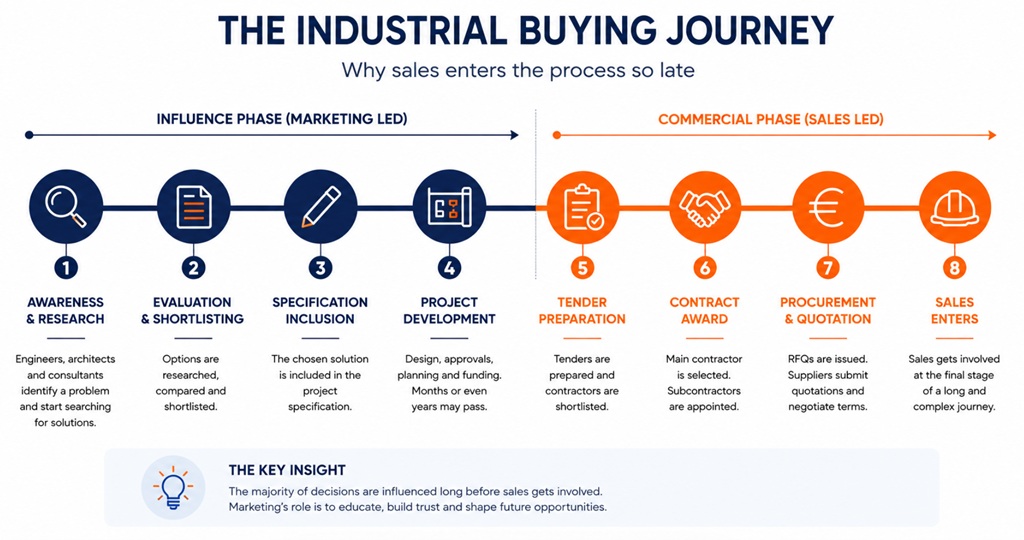
Before your sales team can discuss pricing, delivery schedules, or commercial terms, your solution often needs to become part of a project specification. Before it appears in that specification, someone needs to understand why it deserves to be considered. Before that happens, engineers, architects, consultants, and specifiers need to become aware that the solution exists in the first place.
This means the buying journey starts long before procurement becomes involved and long before sales has an opportunity to influence the conversation.
In many industrial sectors, marketing’s primary role is not generating immediate demand. It is creating awareness, trust, and confidence among people who may shape a project years before it reaches the commercial stage.
Why Industrial Marketing Is Different
One of the biggest misconceptions in industrial businesses is the belief that marketing exists primarily to generate leads.
Lead generation is important, of course. Every business needs a healthy pipeline of opportunities. However, industrial buying journeys rarely begin with a lead. They usually begin with a problem.
An engineer identifies a technical challenge. An architect starts exploring possible solutions. A consultant researches alternative approaches. A project team begins evaluating different ways of achieving a desired outcome.
At this stage, nobody is requesting a quotation.
Nobody is comparing prices.
Nobody is talking to procurement.
Instead, they are gathering information, reducing uncertainty, and trying to understand which solutions are worth considering.
This research phase can last months or even years. During that time, buyers consume technical articles, case studies, specification guides, CPD presentations, project references, and design resources. Every interaction helps them build confidence in a particular approach.
Eventually, a preferred solution becomes part of the project documentation.
Only then does the commercial process begin to emerge.
This is why industrial marketing often feels difficult to measure. The content published today may influence a project that won’t generate revenue until years later. The impact is real, but the timeline is far longer than many organisations expect.
Why More Sales Activity Isn’t Always the Answer
When growth slows, many companies instinctively look to sales for answers.
The response is usually predictable. More calls. More meetings. More quotations. More follow-ups.
The assumption is simple: if revenue is not growing quickly enough, sales activity needs to increase.
Unfortunately, industrial buying journeys rarely follow such a straightforward path.
Consider a typical infrastructure project.
An engineer begins researching potential solutions and spends months evaluating options. Technical documentation is reviewed. Standards are checked. Consultants provide recommendations. Eventually, a preferred solution is selected and included within a specification.
At this point, many suppliers feel they are moving closer to revenue.
In reality, the project may still be years away from construction.
Design development continues. Planning approvals are secured. Funding is allocated. Main contractors are selected. Subcontractors are appointed. Tender documents are prepared.
Only after all of these stages are complete does procurement begin requesting quotations.
By the time a sales representative receives an enquiry, much of the most important work has already happened. The specification may already favour a particular solution. Technical preferences may already be established. Key stakeholders may have spent months or years building confidence in one approach over another.
The uncomfortable truth is that sales often enters the process after many of the critical decisions have already been made.
The Invisible Part of the Buying Journey
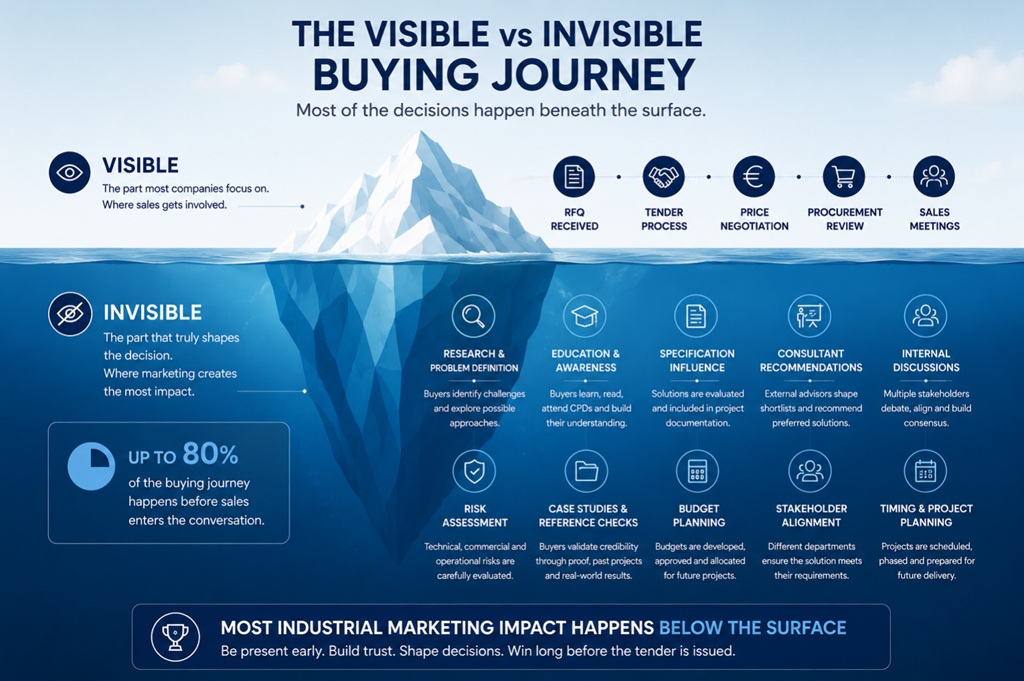
One of the reasons industrial marketing creates so much frustration is that much of its impact remains invisible.
Most businesses prefer clear cause-and-effect relationships. A campaign launches, traffic increases, enquiries arrive, and revenue follows. Industrial buying rarely works that way.
A project that eventually generates hundreds of thousands of euros in revenue may have been influenced by dozens of interactions over several years.
An engineer may have discovered a technical article during the research phase. A consultant might have attended a CPD presentation six months later. A project team may have downloaded a specification guide during design development. A case study could have helped validate a recommendation internally.
Which interaction was responsible for the final decision?
The reality is that this question misses the point.
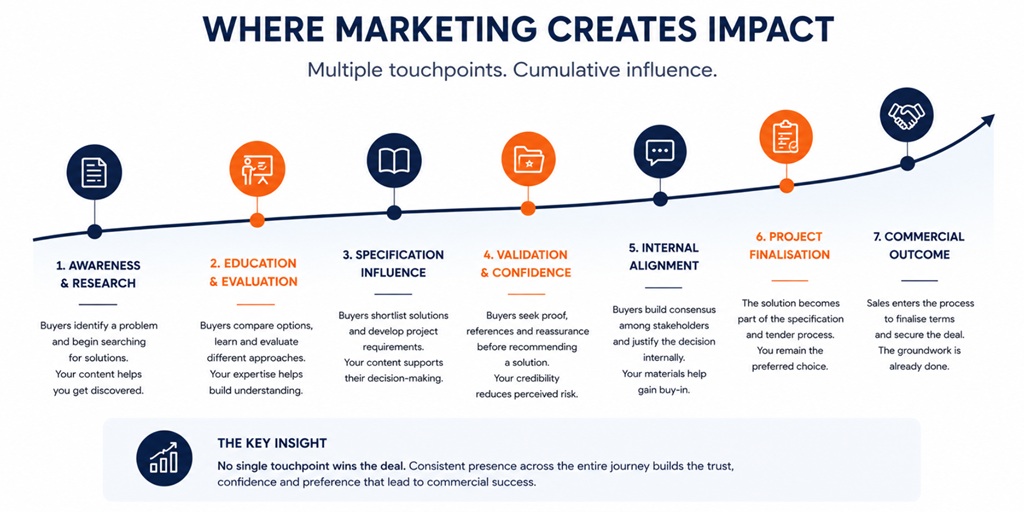
Industrial purchasing decisions are rarely influenced by a single touchpoint. They are shaped by an accumulation of evidence that gradually reduces uncertainty and increases confidence.
Every article, project reference, technical guide, and conversation contributes to the buyer’s understanding of the solution and their confidence in the supplier.
This is why industrial marketing often feels difficult to justify using traditional attribution models. The buying process is too complex, too fragmented, and too long to be explained by a single campaign or interaction.
Why Measuring Marketing ROI Is So Difficult
Many marketing teams struggle with the question of ROI.
Senior management wants to know which campaign generated the revenue. Sales teams want to know which activity produced the lead. Finance wants evidence that marketing investment is delivering a return.
These are entirely reasonable questions.
The challenge is that industrial buying decisions rarely provide simple answers.
Imagine trying to determine which conversation convinced someone to buy a house. Was it the first viewing? The discussion with their partner? The meeting with the mortgage advisor? The second viewing? The survey report?
Most significant decisions involve multiple interactions that collectively create enough confidence for action.
Industrial purchasing works in exactly the same way.
A technical article may create awareness. A project reference may establish credibility. A CPD presentation may provide reassurance. A specification guide may support evaluation. Together, these interactions help move buyers towards a decision.
Viewed individually, none of them may appear responsible for the sale.
Viewed collectively, they make the sale possible.
This is why successful industrial marketers focus less on identifying a single winning activity and more on understanding how marketing contributes to the overall buying journey.
You’re Not Selling to a Customer. You’re Selling to a System.
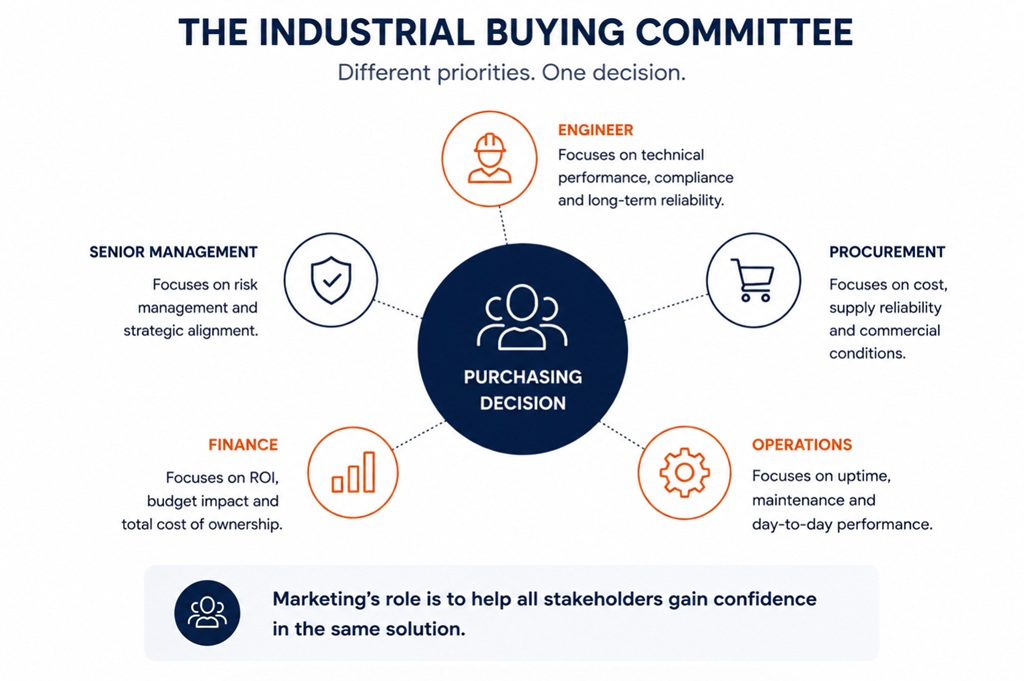
Perhaps the most important lesson in industrial marketing is recognising that you’re rarely selling to one person.
In consumer markets, a single individual often makes the final decision. Industrial buying is very different.
Most purchasing decisions involve multiple stakeholders, each with their own priorities, concerns, and definition of value.
The engineer wants confidence in the technical performance of the solution. Procurement wants confidence that pricing is competitive and supply is reliable. Operations teams want confidence that the solution will perform consistently over time. Finance wants confidence that the investment makes commercial sense. Senior management wants confidence that the decision won’t create unnecessary risk.
The challenge for marketing is helping all of these stakeholders arrive at the same conclusion.
This requires more than product knowledge.
It requires a deep understanding of how different audiences evaluate risk, assess value, and make decisions.
Companies that recognise this build marketing systems capable of supporting the entire buying process. Companies that ignore it often find themselves competing primarily on price.
The Commodity Trap
Many industrial companies face a challenge that receives far less attention than it deserves.
Their products appear similar to those of their competitors.
A drainage system meets the standard. A coating achieves the required level of protection. A packaging solution satisfies the specification.
From a technical perspective, meaningful differences may exist. From the buyer’s perspective, however, those differences are not always obvious.
As products become increasingly comparable, buyers begin searching for other ways to make decisions.
Most often, they focus on price.
This creates a dangerous situation for suppliers because years of technical differentiation can disappear remarkably quickly.
Many companies unintentionally contribute to this problem by focusing almost exclusively on technical features and compliance standards. While these factors matter, they are rarely enough to create lasting differentiation.
Trust, expertise, reputation, responsiveness, and reliability are often far more difficult for competitors to replicate.
Ironically, these are also the qualities that buyers remember most clearly when risk becomes a factor in the decision-making process.
The Four Most Expensive Words in Industrial Marketing
Anyone who has worked in construction or engineering will recognise the phrase.
“Product X or equal.”
At first glance, it appears harmless.
In reality, it can destroy years of marketing effort.
Imagine spending years educating consultants, supporting engineers, creating technical resources, and helping shape specifications. Eventually, your product becomes part of the project documentation and appears perfectly positioned to secure the work.
Then the tender process begins.
Contractors review alternatives and someone proposes a cheaper option. After all, the specification allows an equivalent solution.
Suddenly, years of influence are at risk.
This is where branding, reputation, and trust become commercially valuable. When buyers believe multiple products can achieve the same outcome, they rarely choose solely on technical performance. They choose the option that feels safest.
In industrial markets, certainty often carries more weight than innovation.
Why Content Matters More Than Most Companies Realise
Many industrial organisations still treat content as a marketing output rather than a commercial asset.
The reality is very different.
Industrial content exists to reduce risk.
Engineers don’t read technical articles for entertainment. Procurement teams don’t download specification guides because they enjoy collecting PDFs. Buyers engage with content because they are trying to make informed decisions and minimise the chances of making the wrong choice.
This is why some of the most effective industrial content is also the least glamorous.
Detailed case studies, specification guides, technical resources, CPD presentations, installation manuals, and design tools rarely attract viral attention. However, they play a critical role in helping buyers build confidence and justify recommendations internally.
The purpose of industrial content is not to entertain.
Its purpose is to help people make better decisions.
The Companies That Consistently Win
The strongest industrial organisations rarely treat marketing as a collection of disconnected activities.
They don’t expect a trade show to transform growth. They don’t expect a single LinkedIn campaign to fill the sales pipeline. They don’t expect one article to generate years of revenue.
Instead, they build systems.
These systems help potential buyers discover the company, understand its expertise, evaluate its solutions, and develop confidence over time. Every piece of content, every presentation, every project reference, and every conversation contributes to the same objective.
Individually, these activities may appear modest.
Collectively, they create trust.
And trust is often the most valuable asset in industrial buying.
Industrial Marketing Is Not a Campaign. It’s a Competitive Advantage.
The most successful industrial companies understand something that many organisations overlook.
The purchase order arriving today may have started years ago.
Its origins might be found in a technical article, a CPD presentation, a project reference, a specification guide, or a conversation with an engineer long before procurement became involved.
Most businesses only see the final transaction.
They never see the years of influence that made it possible.
That is why industrial marketing often feels difficult.
Much of its impact remains hidden beneath the surface, shaping decisions long before tenders are issued, quotations are requested, or sales conversations begin.
Companies that understand this stop treating marketing as a series of isolated activities. Instead, they build systems designed to create trust, reduce risk, and influence decisions throughout the entire buying journey.
When that happens, marketing stops being viewed as a cost centre.
It becomes a genuine competitive advantage.